




The trip
In the bowels of the earth hide in Cantabria signs left by the primitive man does 200 ages. A legacy indecipherable in the eyes of modern man. Perhaps it was the first art exhibitions; perhaps it will be a religious use of the paint; might be a language; experts talk about flags. All these hypotheses have been studied as possible in rock art. Today, with weak colors but still latent in the rock, began a visit that takes us back to the Paleolithic.
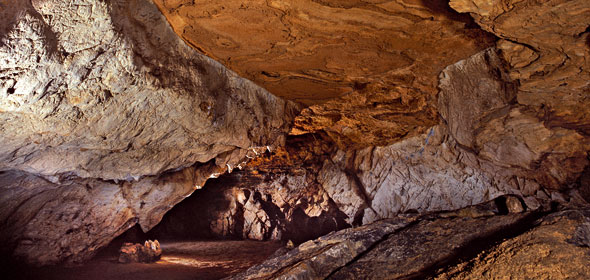
La Cueva del Monte Castle next to the Cantabrian town of Puente Viesgo. Along with four other caves-The Coins, The Pasiega, Fireplaces and Arrow- forms a whole museum of prehistoric paintings of Cantabria. Hitherto, the well-known cave of Altamira had not allowed the rest of cavities had the recognition they deserve.
Mark, a researcher Cantabrian, guide us. Knows perfectly the fascinating rock muscle that lies above and below your feet. The rain that falls out invites in a hurry to get. We started to walk among the rocks until you reach a door; behind her waiting room paints a surprising.
The man's hand
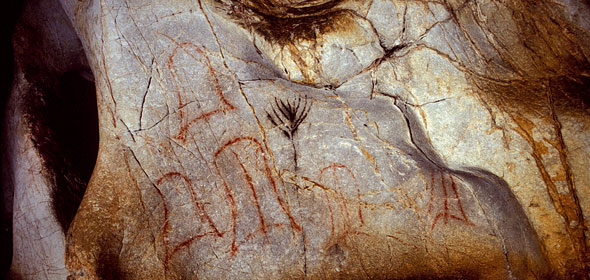
One of the images that come across in the Cave of the Castle are the two dozen paintings of hands. Hands placed by those men of the Paleolithic in these walls. What are these rows of hands (left most) tattooed on the rocks? Mark explains that "all we can say will be a hypothesis, but it seems that it is a communication system ". This is where occurs the first question: with whom communication. On the one hand you would think that in the Paleolithic, made between 21.000 and 28.000 years, humans painted their legs as a sign of possession. Our guide confirms that it is a possibility, but may also "be a man's attempt to merge with nature". Ie, humans painted their hands on the walls as a sign of respect and attempt to understand Mother Nature. "Merging with it", Marcos falls. This theory, in case of certain, would show a first supernatural religious devotion or humans. No painting as an art, but did so to curry favor with the deity, in this case, would be the nature.
All hands were painted red and are the oldest representations of Monte Castillo. The early placed his hand on the rock and painted on it. It is impressive to most of 20 hands are painted in a less high in the cave and foreshortened figures placed.
Like the current flag, squares would be a signal to the tribes of the time. Pure symbolism
But the cave has a complete collection of paintings. Before stopping to comment on the form of animals, Mark explains the so-called "corner tectiform". Is 10 quadrilaterals painted in red, with various lower partitioning. Other signs that can be found in the rock are bell-shaped or herringbone. Untreated, therefore, or animals or man. What are? The same happens with the hands, the explanation is interpretable, but the guide, and researcher, provides an interesting insight: "It could be a kind of flag". ¿Flag? Again interpreting the past to confront the past is complicated, but could be a sign of territorial possession or belonging to a group. Like the current flag, squares would be a signal to the tribes of the time. Pure symbolism. So it seems easy to understand written, but now situate this time, more 22.000 years and seek parallels. Do men of the Paleolithic already gathered around the group or national institutions that should be embodied in a symbol? Appear to be well, but it is surprising nomadic group of origin. Perhaps the cave was one of their homes and wanted to translate it fixed and so. In fact, migration occurred throughout Europe. "There are significant caves in France which has been shown, Pro residues study, Then there were groups that were in Cantabria or vice versa ", explains Mark.
Animals are a large group of paintings tattooed on the rock. Bison, reindeer (arrived surprisingly cold in northern Europe), deer and goats are the repeated figures. Also here is a supernatural explanation on the "prints". The men painted animals as ritual for good hunting. Ie, There is a belief that represent a deer in the cave must have a relationship with hunting the same animal out of the stone walls.
There are already very worn figures that you have to imagine and others whose contour is easily seen. It is curious that the artists used the very shape of the rock to paint his figures. So, looks great painted bison from various perspectives, since the artist seeking the unevenness of the stone to give more realism to his work. "Would be the first cubist", Mark jokes. The reality is that some figures are painted in different planes, which simulates the effect, eg, offered by the horse in Picasso's Guernica.
Cantabria and prehistory
The Cantabria is a world leader in rock art. The discovery in 1879 of the famous paintings of the Altamira Caves sparked a bitter controversy in the years that followed. French archaeologists, Emile como Cartailhac, questioned the validity of the discovery. But, after finding cave paintings in France similar, publicly corrected in an article titled "Mea culpa of a skeptic", in 1902.
It happens then a fever to find new caves with primitive art. Is 1903 where H. Mayor of Rio Monte check Cave Castle. You soon realize that it has discovered a unique and moving up there leading European prehistorians time. In the following years (World War studies sponsored stops then the Paris Institute of Paleontology), new paintings are discovered and the cave widens. Are reached 18 meters. Monte Castillo fever, in the decade of the 50, causes it to discover the caves of The Coins, Fireplaces and La Pasiega.
This is a unique historical and artistic treasure. To understand the step of man on earth, have to look at these prehistoric caves and discover their way of life. Religion, the sense of private ownership or state may have as early as 28.000 BC obvious way. Go visit these caves is the most longstanding history. Addition, is unique locations. Is understood or not what you say there, language is depicted, only see the paintings is already a privilege subject to time forgot.
The road
From Santander take the A-67 and then, outside, the N-623 to Puente Risk.
A nap
–Gran Hotel Balneario Puente Viesgo. Spectacular, a luxury that has served more than one occasion of accommodation for the concentrations of the Spanish football team. More information www.balneariodepuenteviesgo.com.
A table set
–The gazebo Amos, Pontoon in Villaverde. Despite be 35 miles away from Bridge Risk, worth a visit to this temple of food. He has had a Michelin star and its menu, based on the season food, is an unforgettable delicacy. The wine list and the possibility of marriage is very remarkable. More information www.cenadordeamos.com. Price per person close to the 100 EUR
-In Santander, a cheaper option, have to eat the delicious anchovies Casa Lita, Joseba made teacher (a luxury). Paseo de Pereda, 37. Search, also at the center, Zachary House is another place of worship. Fresh and delicious. Calle General Mola, 41
Highly Recommended
–Cave Soplao: Since we caves, approach the singular cave is a good idea Soplao. No history, but a great burst of nature. This is an old tin mine abandoned mining has given way to a single site. A huge space full of stalactites and stalagmites with impossible shapes. There is just produced a major scientific discovery, the finding of a mosquito 110 million years preserved in amber.


