
Every book can be summarized in 6 paragraphs ....
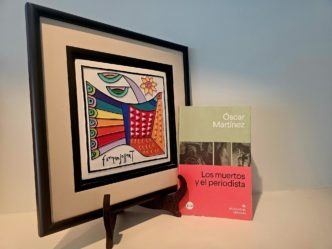
- Anagrama editions. Edition 2021
- Author: Óscar Martínez
- Book for interested in: El Salvador, violence, gang members, corruption, journalism (especially recommended to journalists and journalism students).
- What will? The author, Specialized in events in the world then more violent in the world, It narrates through a real case that covers the atrocious reality of a rotten society by the violence of gangs and political and police corruption.
Paragraph 1
If that Sunday night 16 April 2017 I would not have appeared in the canton of Santa Teresa, Maybe Herber would not have been killed to machetes on the face; Maybe Vito would not have been beheaded; Maybe Jessica wouldn't have had to flee. a, To that yes, I think they would have killed him anyway.
Thus begins ‘the dead and the journalist’. The first paragraph of a work that already teaches you the end. The beginning of a masterpiece of the chronicles of violence that tells that there are people born with almost inevitable destinations. You know what will happen, But you don't know how, And that is the fascinating part of this work.
Paragraph 2
We chose it (Talk about Dennis, A character) because, Although one does not write to please the convictions of any reader, Yes, he writes for readers and we think that saying that someone was not a gang member would maintain the attention of those who would not be interested in the death or massacre of a group of gang members. We enter a swampy land on which I have no lesson to give: understand readers.
The work constantly delves into that ethical debate that is to defend or not the rights of that that most of the society considers murderers. A gang member, In a country that as the book pointed out, it reached the record fee of 103 murders each 100.000 inhabitants, He is a human being to worry about his rights? Dehumanize criminals, take away the category of people, Dehumanizes society? Can the State allow the police to decide who to take their lives, How to do it, when? And what happens when that police are as corrupted as the evil that confronts? All these issues swarm for the work and sometimes do not have a precise answer.
Paragraph 3
In these countries we kill each other a lot, more than normal, More than the abnormal planetarily acceptable, We kill ourselves as an epidemic. The usual in the region (Central) In these last ten years it is that the homicide rate exceeds 40 for each 100.000 inhabitants. How is a human monster created? How are so many? (…) 2015 ended with a rate of 103 homicides for each 100.000 inhabitants. One of each 970 Salvadorans was killed that year.
Read that last sentence and reconside on that last figure. Imagine for example a football field. Let's say there is 50.000 people inside, encouraging your team, singing, celebrating ... and suddenly because of the megaphony someone will announce that, at least, 50 of them will inevitably be killed in the next twelve months. That is the environment in which this story develops.
Paragraph 4
Normalize violence is not to stop suffering, but naturally understand some aspects that should be discovery and not established knowledge. Not just understand them, but incorporate them into daily dynamics: What bus take and what bus not drink every morning? How to respond to the greeting of a policeman, How to respond to the greeting of a gang member? What to do if they sound bullets, What to do if agitated steps sound on the street, WHAT TO DO IF THEY SAY GROSON OF Aid? Where to hide money? Take a razor, wearing an American fist? Never sit against the bus window, Lock at home after sunset, Lower the car lights to enter the colony, Do not take children to the park.
The figures are sometimes cold, Far. In the simile of the paragraph 2 of violence, There will be readers who think that if they do not go to the football field they are not risks. But violence, Martínez explains, It is much more than a corpse. It is a day to day that corrupts and deforms everything. A virus that makes the unusual, The unacceptable, become routine.
Paragraph 5
It was not condescension, I was not inspired by that town midwife. Nor was it empathy. The woman disgusted me. It was the conviction that if that criminal group learned that the survivor of a massacre was still there, so within reach of a burst, I would not cost him anything to finish what started. Then I took the name. I did it, I decided on the computer and against its will. One protects sources, Not only to the perfect victims. One must sometimes protect the lady who prostitutes migrant women on a border.
The book is of course a journalism treaty, or what he holds as a good journalism. No moral alharacas, But with forcefulness, No half inks. Should a source be appointed in an article? Does a text lose credibility in which there are no recognizable names? Martínez decides not to do it for a double reason. First, Before that paragraph explains that the midwife does not really understand what it means to speak for a medium and its consequences. And second, He knows that citing her places her at risk of death because she discovered that she was involved with a killing of a Guatemalan poster in which she was the only survivor. That openness in which the author is placed in front of the mirror and opens debates about his own acts is a constant in the entire work.
Paragraph 6
Over: ‘They already killed him, These sons of whore already killed him ’. I asked Fred to turn around and follow the patrol. Then one of the most unlikely scenes of my career as a journalist occurred. For a few kilometers, We chase a patrol that fled from Yaris de Fred (The photographer who accompanies him) at full speed on a dreary road in Santa Teresa. We pito to stop and accelerate more ”.
The rhythm is one of the great achievements of this book. You end up in that car, chasing ghosts, On the closed night of a stiff world. And then everything stops, And the silence of inevitable death falls, and leave a trag of questions, To all, To the society in which we live, spectator, When not the protagonist, of third person terror.
| Style | 9,50/10 |
| Content | 10,00/10 |
| Valoración | 9,75/10 |