
Every book can be summarized in 6 paragraphs….
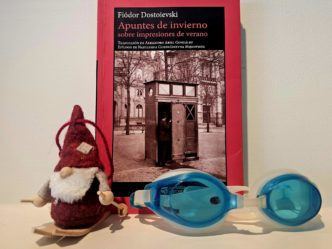
- Hermida Editors. Edition 2017
- Author: Fyodor Dostoevsky
- Book for interested in: Russia and Europe in the 19th century, Dostoevsky, custom, Travel, Dostoevsky's thought.
- What will? The Russian narrates in 1863 his first trip to Europe -Germany, United Kingdom and France-, and leaves a whole series of reflections, sometimes parallel to the route, of what you see and the thoughts they produce. In many instances, His real debate is about his own homeland, which he puts in front of the mirror of cities like Paris., London or Berlin. Some depth is missing about the trip itself.
Paragraph 1
I consider myself a scrupulous man and I would not like to lie at all., not even as a traveler. It's just that if I started to paint or describe even just a panorama, without fail I would have to lie, and not at all for being a traveler, but simply because in my circumstances it is impossible not to lie. You judge: Berlin, eg, It made the most bitter impression on me and I was there for only twenty-four hours..
There are several moments and phrases in which the author explains that he does not want to lie., but know, that without wanting to and without knowing it, will end up doing it. The Russian is afraid of having accelerated impressions and questions his own conclusions.
Paragraph 2
All those phrases that make foreigners look like a rag, even if we find them now, they hold for us, the russians, something irresistibly pleasant. Of course only in the greatest of secrets, sometimes even hidden from ourselves. A certain revenge resonates in them for something past and offensive..
The text is sometimes more interesting because of what it explains about Russia and patriotic sentiment than what it tells about Europe., where sometimes somewhat superfluous evaluations appear. Dostoevsky gives many keys to his country while comparing it with the then great capitals of the world..
Paragraph 3
But now it's not the same, and Petersburg has taken its own. Now we are completely European and we have grown. Now Zurranin himself knows when he has to spank, observe decorum, becomes a French bourgeois, will go a little further and, just like a citizen of the Confederate States of America, will begin to defend the need for black trafficking.
Perhaps the great quality of this text is that it reflects the vision of issues such as the violence that women endured., slavery, the bourgeoisie and the proletariat, what was there then. The, at least, Dostoevsky had and his social and cultural environment that he talks about. Everything new is very old, again one of the teachings of the classic works that we never tire of repeating in 6P.
Paragraph 4
everyone is drunk, but without joy: somber, sorry, all terribly silent. Only occasionally insults and bloody brawls disturb that suspicious silence that instills sadness.. Everyone rushes to get drunk until they lose consciousness.
The description belongs to the city of London. Dostoevsky points to the problems he observes among a working and urban social class that emerges under the smoke of the industrial revolution. More than 150 years after, Have some London neighborhoods changed a lot?? Maybe they make more noise now.
Paragraph 5
“What freedom? The same freedom for everyone to do whatever they want within the limits of the law. When can everything you want? When you have a million. Does each million give freedom? Not. What is a man without a million? A man without a million is not the one who does everything he wants, but that with whom they do everything they want.
Some of the political and social diatribes that Dostoevsky writes seem designed for the 21st century.. The work leaves a trail of reflections of a new Western civilization that emerged and that has led to what we are today..
Paragraph 6
I especially remember a very kind old man, very nice, very good, which honestly suited me very well. He looked me in the eyes in such a way when he asked my opinion about Paris that he became very bitter when I did not express any particular enthusiasm.. Even pain was reflected in his kind face, literally pain, I'm not exaggerating. ¡Oh, querido Mr. Mother! It has a French, namely, to a Parisian (because deep down all French people are Parisians) You will never convince him that he is not the first man on the entire globe. Otherwise, from all over the globe, With the exception of Paris he knows very little. And you don't want to know too much. That is a national trait.
There are funny moments in the story, where it points to stereotypes that have been maintained over time. His admiration and at the same time disdain for Paris, they are a coming and going in the work.
| Style | 9,30/10 |
| Content | 8,50/10 |
| Valoración | 8,90/10 |