




They believe in everything that can be believed. They embrace the gods of Hinduism, to the teachings of Muhammad and the legacy of Jesus Christ. Are buddhist, Taoists and Confucianists. Its leaders claim to have received revelations from Shakespeare or Lenin. And Víctor Hugo is one of his saints.
This labyrinth of characters, This communion of doctrines, It is called caodaism. "All religions are one". That would be his main premise and the truth is that it seems like a message to me, at least, seductive. That is why we move away a few kilometers from the city of Ho Chi Minh to reach the Cao Dai temple, One of the most important of this religion. We had to see it, Check if that was possible. It seemed incredible to believe like this or, maybe, By force of complicating creeds, Everything was simplified.
Some might think that this type of cult has some sect, of ideological extravagance, But it turns out that in Vietnam there are more than seven million followers that practice caodaism. And apparently, Religion continues to grow and expand in the United States and Asia. Even in Spain there are already some caodaists.
Religion continues to grow and expand in the United States and Asia. Even in Spain there are already some caodaists.
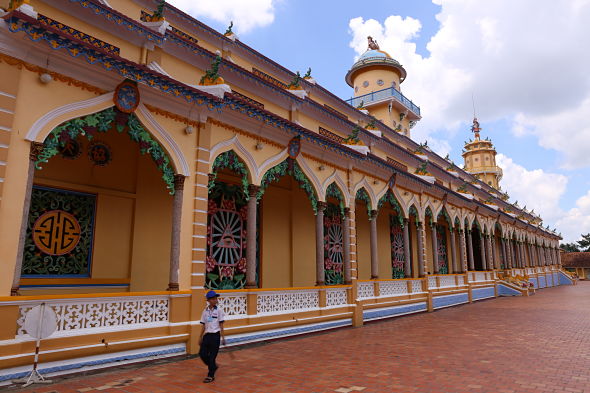
Curiosity became pure astonishment when we reached the temple of Cao Dai. It has dimensions of cathedral and is loaded with filigree. The yellow facade is decorated with floral motifs, CELOSIAS AND ORNAMENTS COLUMNS.
And then we entered to discover that this was much more serious than a mere hippies believers meeting. A fresco showed his three saints: Sun Yat-set, Founder of the People's Republic of China, Nguyen binh khongem, A Vietnamese poet and educator and the French writer, Victor Hugo.
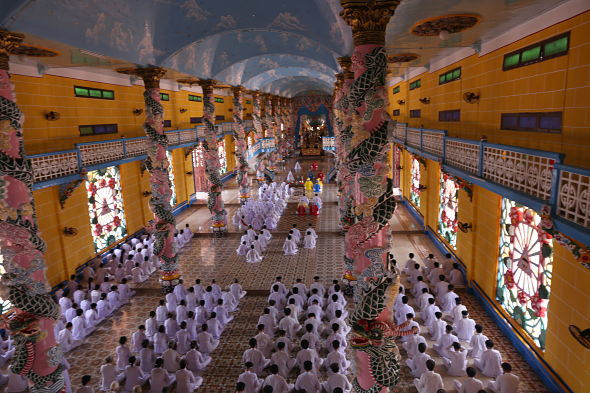
A group played a kind of Vietnamese music before the ceremony began. Men and women wore a heavenly target. The act had unequivocal solemnity, Of those that force one to walk on tiptoe. The curious told us that we should climb to the choir, To see from there the ceremony.
Inside the temple there are no banks. The faithful sit on the ground and make their reverences in front of an altar whose most recognizable symbol is that of a triangle housing a great eye. The pink columns are surrounded by dragon figures with snake bodies. It is a huge sanctuary painted with the imagination of a child.
Being caodaist must be very stressful because each act attempts against a particular religion and the sum of beliefs is also moral duties.
Only religious leaders carry red tunics, yellow or blue. The rest wears an unpolluted white. The ritual has a military order, A child color and an exaggerated faith. I had thought that a religion of religions would be more open in its precepts, somewhat anarchic in virtue and sin, But once there we find much more complex dogmas. There are sharp prohibitions and I didn't notice a cheerful atmosphere as I expected, but a circumspect mood.
I concluded that being caodaist must be very stressful because each act attempts against a particular religion and the sum of beliefs is also moral duties.
Out, a man who deduced had just ordered or made communion or baptism or whatever they do, posed next to a sacred tree. The stamp, I had to admit, had an almost mystical countenance.
The interview with the spiritual leader of the temple lasted a minute. I asked him if he was not a bit paradoxical to believe in religions sometimes so distant. The micro was removed and walked without further explanations.
Back to the old Saigon, We saw more caodaist temples, With its yellow facades, His towers and faith pointing to all possible heavens.


