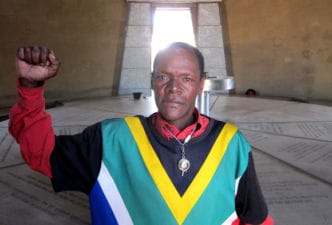
The next time you write a post in this journal will be already in Africa. Return to the place I never left. Strange feeling to these months of being without being, I left without going. And in this impasse is always expected after a long journey, no return ticket and will last what I last, I have never seen a film that has always accompanied me: Invictus. I saw before I left to live in South Africa in 2010 and there I saw several times by my fascination with the character. Just for the scene that repeats the poem by William Ernest Henley in Mandela's cell worth seeing a few times.
A letter which speaks of the same epic and resistance to adversities that narrates the poem
But, reading on the subject found that Clint Eastwood's film had allowed a license that modifies reality. A game with the story and the words. The famous Nelson Mandela text delivery captain of the South African rugby, Francois Pienaar, is the poem Invictus, which gives the film its name, but a fragment of a speech by U.S. President Theodore Roosevelt who performed at the Sorbonne in Paris on 23 April 1910. A letter which speaks of the same epic and resistance to adversities that narrates the poem. A lyrical for elected, intended for great things beyond their limits. El texto se titula “Man in the Arena” (Man in the Arena) and reads:
Man in the Arena
"I do not care for criticism; or those showing deficiencies of men, or on what occasions those who did something they could have done better. The recognition belongs to men who are in the sand, with dust-stained faces, sweat and blood; those who persevere with courage; those who err, facing a setback after another, since there is no victory without stumbling, effort without error or defect. Those who really are determined to achieve their goal; who know the enthusiasm, devotion; those who are engaged in a noble cause; who at the best at the end the triumph of great achievement inherent; and that in the worst case, si fracasan, at least fall with head held high, so that his place shall never be among those souls who, cold and timid, know neither victory or failure ".
The recognition belongs to men who are in the sand, with dust-stained faces, sweat and blood
So then why in the movie Invictus discussing? Because it was Mandela's favorite poem he read repeatedly in his long stay in the Robben Island Prison. An antidote to weakness and fear. One way to convince yourself that you only win when you are ready to go missing as he. I know I will, as I have spent these years, by empathy not suffering, that at some point I'll be walking somewhere and detain my mind trying to remember these verses. Then I remember Mandela, of that long-ago film session in Madrid and smile.
In the middle of the night that covers me,
black abyss as he pole to pole,
I thank whatever gods may be
For my unconquerable soul.
In the fell clutch of circumstance
I have not regretted nor have I cried.
Under the bludgeonings of chance
My head is bloody, but not cowed.
Beyond this place of wrath and tears
Horror imminent approaches of shadow,
and yet the menace of the years
I finds and shall find me unafraid.
It matters not how strait the gate,
How charged with punishments the.
I am the master of my fate:
I am the captain of my soul.
Original in English
Out of the night that covers me,
Black as the pit from pole to pole,
I thank whatever gods may be
For my unconquerable soul.
In the fell clutch of circumstance
I have not winced nor cried aloud.
Under the bludgeonings of chance
My head is bloody, but unbowed.
Beyond this place of wrath and tears
Looms but the Horror of the shade,
And yet the menace of the years
Finds and shall find me unafraid.
It matters not how strait the gate,
How charged with punishments the scroll,
I am the master of my fate:
I am the captain of my soul.