



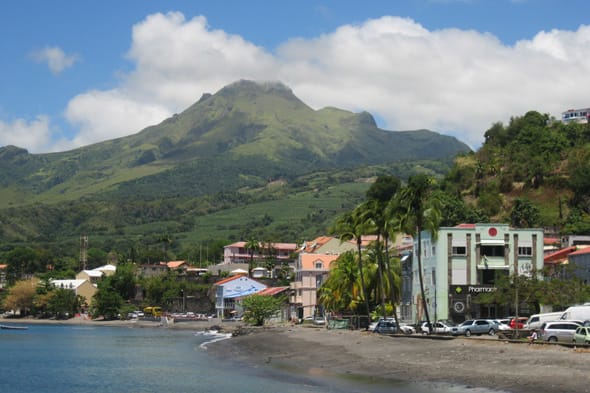
From the top of their 1397 meters, Mount Pelee dominates the French island of Martinique, In the minor Antilles. This stratovolcán, that began to form some 300,000 years, extends on a surface of 120 km², north of the island. Attracts numerous local and foreign visitors, that travel their skirts, Following beacon and maintained by the authorities. In the course of his rise, Hikers can appreciate the fantastic reliefs and the prodigious biodiversity of the volcano, covered with different types of forests and savannas.
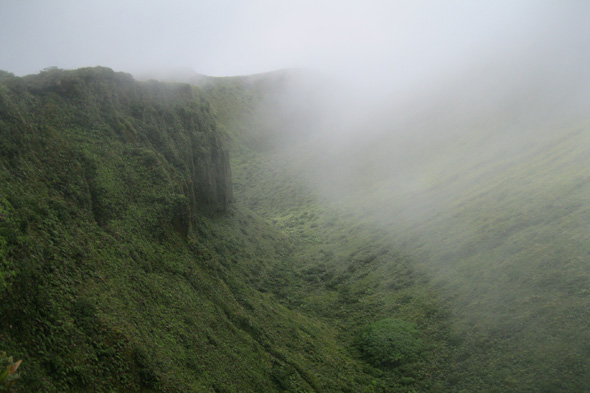
Arrivals to the Summit area, Several lava domes discover there, produced by successive rashes, and a sliced ??slope crater. In this cold environment, Shakeing for winds and often cloudy, Mainly a dense savanna grows, composed of small bushes and herbs. But, at the bottom of the crater, The hollow of the dry pond reveals arborescent ferns and strange palm trees, creating a landscape worthy of Lost world Arthur Conan Doyle.
Mount Pelée is active and potentially dangerous
The tranquility that reigns, today, In these places, It should not fool us: Mount Pelée is active and potentially dangerous. For centuries, Men are subject to their moods, Sometimes terrible. The excavations carried out in the vast archaeological site of Vivé, northeastern Martinica, They showed that the settlement was abandoned by its inhabitants after an eruption that occurred around the year 280 d. C.
The Volcano Experiment Other Fury Access During the pre -colonial era. One of them took place very little before the installation of the French, in 1635; earned the colossus, whose vegetation had been devastated, His current name of Monte "Pelado". And 1792, He experienced two water tables, Without great consequences. He became more threatening in 1851, Falling ashes rains in the villages of Le Morne-Rouge and Le Prêcheur, And in the city of Saint-Pierre, The island's economic capital, Nicknamed the "little Paris of the Antilles".
Asolaron Saint-Pierre, killing more than 28 000 People
The most tragically famous eruption of Mount Pelée occurred in 1902. That year, the 8 May, after weeks of worrying but misunderstood phenomena then, a titanic explosion rumbled at the top of the volcano. In the seconds that followed, a shock wave and a pyroclastic flow devastated Saint-Pierre, killing more than 28 000 People. This cataclysm caused stupor in the world. In France, In addition to multiple charity actions, An official assistance and assistance committee was created, and a national subscription was organized.
On the other hand, U.S., Russia, The Netherlands, The United Kingdom, And even Germany, that then maintained a hard rivalry with France, They contributed humanitarian aid. However, The volcano had not finished his work of destruction and death: After that fateful 8 May, spit several more pyroclastic flows. The 30 August, one of them kill some 1400 inhabitants of the municipalities of Le Morne-Rouge, The adda-bouillon, Basse-point there the Lorraine.
The birth of modern volcanology, Under the impulse of Alfred Lacroix
This eruptive period, one of the most deadly in the history of humanity, had another remarkable consequence: The birth of modern volcanology, Under the impulse of Alfred Lacroix. The illustrious French scientist, Professor at the National Museum of Natural History and soon a member of the Academy of Sciences of France, installed two modest observation positions of the volcano from 1902.
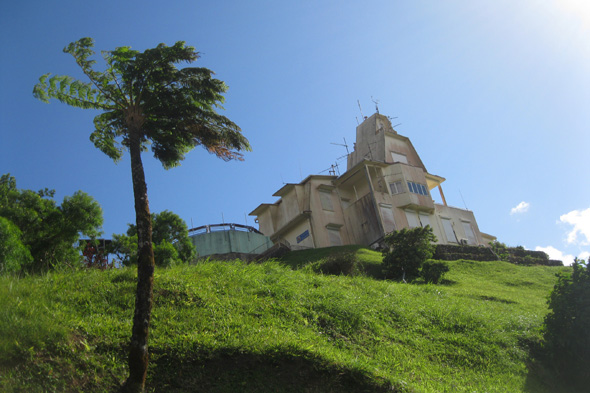
The following year, Cerro Morne des Cadet position, In Saint-Denis funds, was become a permanent observatory. And after a new period of violent activity of Mount Pelée, between 1929 and 1932, A formal building was built to house the observatory. Today, The colossus seems to sleep, But it is still closely guarded by scientists.
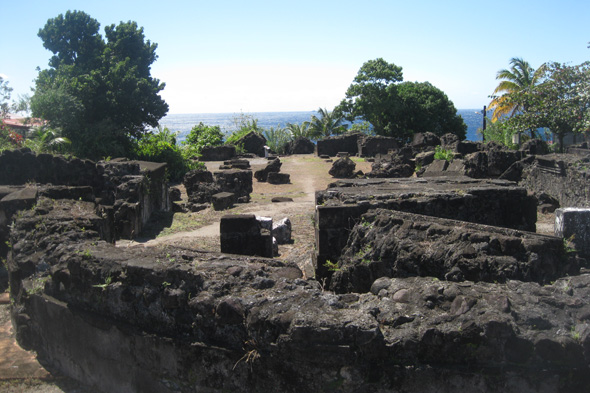
It is possible to visit the Cadet Morne Observatory, with previous appointment. Also, The public can be informed about the life and history of Mount Pelée, Visiting the Volcan House (The Morne-Rouge), The Earth Science Discovery Center (Saint-Pierre) and the Franck Museum A. Perret (Saint-Pierre), where various objects that were tortured and deformed by the pyroclastic flow are exhibited, the 8 May 1902. Other Testimonies of the Funess Day are provided by the ruins of Saint-Pierre, especially those of the theater, THE FUERTE CHURCH, The colonial health house (The psychiatric), The Office of the Corps of Engineers, The prison and houses of the Figuier neighborhood.
Various objects that were tortured and deformed by the pyroclastic flow are exhibited
In order to assess the cultural and natural heritage of the north of the island, The Regional Council of the Martinica (The Deliberative Assembly of this French administrative region) Throw, in 2010, An ambitious initiative: The mission of "Great Saint-Pierre". This is supported by the European Union, The French state, municipalities and companies, and coordinated by the writer Martiniqués Patrick Chamoiseau. The projects you develop, In Saint-Pierre, They include the rehabilitation of the old botanical garden, The conditioning of the city's boardwalk, The implementation of organized anchor areas and a host space of navigation fans, a better dissemination of information related to sunk heritage in bay (And especially, The remains of ships), the foundation of an underwater archeology center and the 3D modeling of the city before 1902. On the other hand, The Great Saint-Pierre will conceive a tourist circuit that will travel the northwest of the Martinica.
But another of its great projects is to promote the registration of Mount Pelée in the Unesco World Heritage List. This year, An important step was taken in this direction: France included the legendary volcano in the indicative list of cultural goods, natural and mixed that submits Unesco, in the hope that the international organization proclaims its "universal exceptional value".
Author:
Sebastien Perrot-Minnot. Dctor in Archeology of the University of Paris 1 (Pantheon-Sorbonne), and researcher associated with the University of the Antilles and La Guyana


