


The trip
The rocks create implausible ways, writhing on themselves, Tues defiantly stuck. We walked slowly, observing each of the colored stones piled the horizon. We in Britain, Perros-Guirec. There the wind and waves have sculpted a unique landscape: the pink granite coast. As is, reddish rocks where the sea is churned. It's just part of a long historical trail known as "customs" of more than 1.300 km. We asked the guide let us see some of the spectacular scenery and some traveling companions embark on the route on foot.
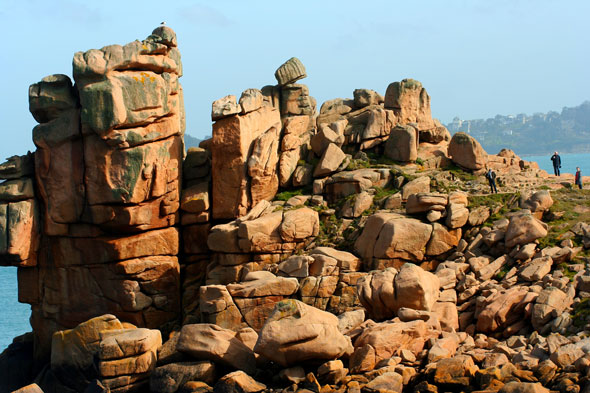


All long way, that connects the port of Saint Nazaire, Loire-Atlantique, con el Mont Saint Michel, Normandy, is now a country lane, the GR-34. Then explain because it is known as the customs, but first I will dwell in the language of that place. There is a sense of calm, perfectly ordered disorder, space which hear the sea, slow walk to get anywhere. Clearly the pink granite coast has the charm of color mixing: the red and white stones and blue waves. There is a point at which a breach of the difference tones maca. Suddenly, out of the blue, attached to other dark colored rock formations, begins the peculiar stone museum. Five miles of red scattered over the sea. Why are these rocks pinks? He explains the guide is iron which contributes to the stones that tone, which are also composed of feldspar, quartz and mica.
Five miles of red scattered over the sea. Why are these rocks pinks?
Each training appears to mean something. Spend as in the Enchanted City of Cuenca, there are stones that have been named to represent. Where is the known as the Devil? I was not able to recognize it in all the way, even though I had bought a postcard in town served me clear guidance. Other say it is the head of a dog and so many analogies.
The journey is a comfortable ride, undemanding for eight kilometers physically. It can be done by bicycle or on foot and is well signposted. Another thing would be to launch the centenary trail over 1.300 miles along the French Atlantic coast.
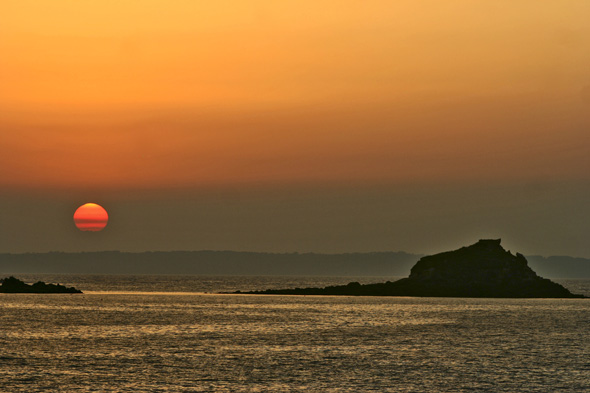
Along the way there is a lighthouse; a rest stop and listen to the roar of the sea, there hardest hits. Later last surprise lurks: Hotel Castel Beau Site. A small hotel with breathtaking views. A calm sea inlet dotted with red rocks and whose beach is the tranquil hosting. Opposite him an islet crowned with a castle. He rose in the nineteenth century and today, tell us in the hotel, lies a German actor. Before, was the resting place for famous French architect Gustave Eiffel. All environment seem to form a postcard seems made. The sunset makes sharing colored rocks and sky; Dawn is just as fascinating. For those who want to visit Britain and only cover a part of the legendary Route, hotel is an excellent. "They come many international models and actors", count in the Castel Beau Site. Not a luxury hotel, but it has great views and a unique tranquility. Tip, ask that the room has the best view possible of the small bay.
High Road
The pink granite coast is only part of the long-GR-34 which is the path of the customs. More than a month is required to traverse a path that dissects the French Atlantic. For those who wish to undertake daring adventure that will tell you down to the Loire-Atlantique region to begin their steps. Yes, expected end historic site, mystery and beauty, como es of Mont Saint Michel, whose membership have debated for centuries between Bretons and Normans (belongs to Normandy, although it is almost in the border between the two regions). Maybe some already know the spectacular abbey, but for those who have not seen her do is another recommendation, at least, the end of the path. What will they see those who decide to do the whole primitive way? You see the sea in all its magnitude. The sea when mixed with soil, people living with him, with its high cliffs, landscapes of dunes and gorse, thorny bushes of yellow flower.
expected end historic site, mystery and beauty, como es of Mont Saint Michel, whose membership have debated for centuries between Breton and Norman
Why is called the path of the customs? "Long time ago, the French state decided to impose a toll on imported products. He had already thought something like that in Roman times and in the eighteenth century when it decides to implement the plan.
Quickly, authorities realized that they had organized a smuggling system to circumvent the payment of taxes. So under Napoleon Bonaparte created a body of more than 35.000 customs 'hunted' sea smugglers. Later expanded the work of these customs, they should also monitor the looters of wrecks in the area, because the laws say that any debris that hit the coast belonged to the state and should be declared at customs ", France explained in Tourism.
It got to the point that it created a whole structure around the coast to catch smugglers. In some cases, customs themselves disguised as pilgrims or camouflaged among nature not to be recognized and to report all illegal landings. It is known since this path as long as the customs for years had to get around on foot to prevent tax evasion.


