




We can find them on the shores of an intense blue sea, in green hills, in picturesque urban spaces, or in the middle of lush tropical vegetation. As Balzac would say, produce a “charming effect on the landscape”. The fortifications represent a prominent aspect of the architectural heritage of Martinique, an island of about 1100 km², which is part of the French Antilles.
In fact, a visitor arriving at the head of Martinique, Fort-de-France («Fort of France»), It doesn't take long for you to notice the imposing silhouette of Fort Saint Louis, reflecting in the calm waters of the Caribbean Sea. The site, which constitutes a base of the French National Navy, It is open to the public every day, since july 2014. At first sight, gives the impression of a rock. Its high walls surround a set of bastions, casemates, Room, alleys and galleries. In a massive tower, which dominates an internal entrance, the visitor discovers a museum, which presents the tumultuous history of the place.
The construction of Fort Saint Louis dates back to 1638
The construction of Fort Saint Louis dates back to 1638, and continued actively until the 18th century. The fortress changed its name several times, at the mercy of wars and political upheavals. It was called, first, Fort-Royal (“Royal Fort”), and gave his name to the city that has been renamed, since, Fort-de-France; established in 1669, This agglomeration became the political capital of the island in 1692. On the other hand, the fort has been called Fort Louis (in honor of the king of France Louis XIV) in 1680, Fort Edward, during the British occupation of Martinique (in 1762-63, the 1794 a 1802, and 1809 a 1814), Fort of the Republic in 1793, under the French Revolution; again Fort Louis, in 1802, by decision of Napoleon Bonaparte; and Fort Saint Louis in 1814, when the monarchy was restored.
Located in the same city, Fort Desaix is, as for him, hardly noticeable from the coast: crown a hill, whose trees cover, in part, the fortifications. From the sky, You can see its extension and unique plane, with tips. The complex belongs to the army; It is accessible to the public during European Heritage Days, organized every year, a weekend in September. Your building, in the second half of the 18th century, It was justified by the need to protect Fort Saint Louis. Named Fort Bourbon, It was called Fort George by the British and Fort of the Convention by the French revolutionaries.. It owes its current name to Bonaparte, who wanted to honor the memory of one of his generals, Louis Charles Antoine Desaix.
Al on the Fort-de-France bay, a volcanic and forested islet, El Islet in Ramiers, also reveals fortifications. Like Fort Desaix, It is open to the public during the European Heritage Days. Its fortress was raised in the 18th century, to consolidate the defense system of Fort-de-France.
It was devastated by an eruption of Mount Pelée
In St. Peter, on the northwest coast of Martinique, the visitor can see mighty walls, but nothing resembling a fort. In effect, in 1902, the brilliant city was the victim of a tragedy that horrified world opinion: It was devastated by an eruption of Mount Pelée. Today, fields of ruins and museums perpetuate the memory of this cataclysm. Among the buildings that were knocked down like houses of cards by the volcano, there was Fort Saint Pierre, whose history is linked to the beginnings of French colonization in Martinique. The stronghold was created in 1635, and transformed on several occasions, throughout the 17th century. The first French settlement on the island was formed around it, which was the political capital of Martinique before Fort-de-France, and its economic capital, to 1902.
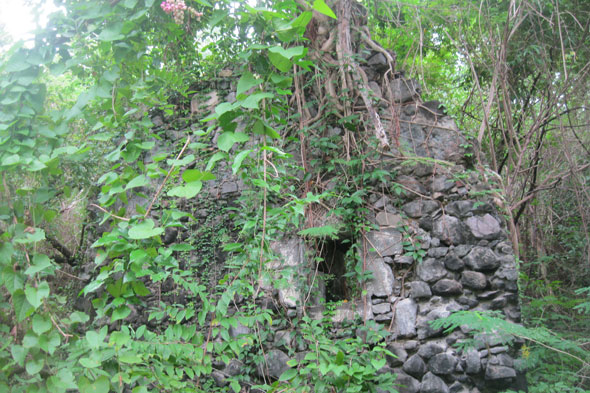
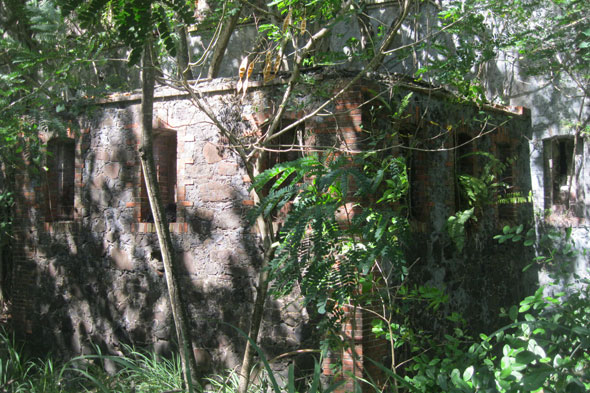
A curious person will be able to discover numerous other fortifications, scattered in the 34 municipalities of Martinique. Some are located along hiking trails.. This is the case of the Sainte Marthe Battery, located south of Saint-Pierre, in the Butterfly Garden; among its ruins, invaded by vegetation, We found a discreet sign announcing: “Battery of the century 17. Fort, gunpowder, canon". Sometimes, toponymy provides indications about local heritage. In Pilot Case, A neighborhood bordering the sea is named “La Batterie”. Preserves thick walls, which are the remains of an enclosure from the late 17th century. Other remains have fallen, practically, in oblivion. Along the coast on the Fort-de-France bay, close to busy beaches and businesses, a grove hides the ruins of the Fort de la Pointe du Bout (municipio of Les Trois-Ilets). Installed in the 18th century, The square was the scene of various construction stages, military and civil, that continued until the last century.
The strength of the defenses of Martinique is evoked, also, through countless cannons, scattered in the landscape; some of them have been reused, to decorate parks and walks.
Not less than 180 fortified works have been built on the island
According to archaeologist Laurence Verrand, no less than 180 fortified works have been built on the island, between 1635 and 1845 (the golden age of this type of structures). They were established, for the most part, unless 500 meters from the sea. In the seventeenth century, often, An artillery post was installed first, in a suitable natural location, and then create a battery, with trenches and palisades, before erecting a stone complex. It should be noted that certain coastal areas were never provided with military works, since they offered natural obstacles (like swamps or cliffs) to the invasions.
The efforts dedicated to the defense of the territory illustrate the importance that the colonial power granted to the island, due to its location in the heart of the Americas, and its rich agricultural production (sugar bowl, especially). The fortresses were intended to protect the colony as a whole., communities or fincas, of the attacks of the indigenous Caribs (in the seventeenth century), pirates and enemy armies, mainly Dutch and English.
They were used, also, for the organization of expeditions on the American continent, in the context of the United States War of Independence (1775-1783) and the French intervention in Mexico (1861-1867). On the other hand, served to repress or prevent internal disturbances. Fundamentally, They were symbols of possession and authority.
Since the end of the 19th century, with the evolution of war techniques, international relations and social life, The forts of Martinique progressively lost their strategic interest, and many were abandoned. But, slowly but surely, your luck is changing: more and more initiatives seek to value these fabulous cultural treasures.


