

In the footsteps of Darwin in the Pampa and Patagonia
Of 18 the 29 March 2013
The epic journey of Charles Darwin a shore del Beagle was the starting point for their (r)Evolutionary Ideas, but not many people know that his famous theory of evolution is based, largely, in their observations during their passage through Uruguay and Argentina. On this trip we will keep part of their journey by the Rio de la Plata, Pampas and Patagonia and relive many of their experiences.
Following his diary find amazing animals, visit spectacular scenery and fascinating historical sites while their writings teach us a lot about the natural history of the region. Following his footsteps to relive the experience gaucho drink mate, eat barbecue, ride through the pampas and hear stories of Indians in the light of a campfire, but we find fossils, sail the same waters and find many of the landscapes of those recorded English naturalist Tour 180 years back.
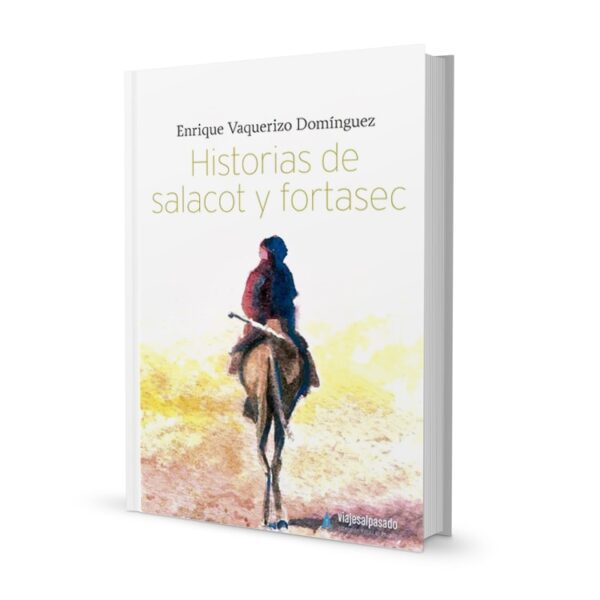
Your prints will take us to the old city in Colony (Uruguay), the restless and yet sensory Buenos Aires, to search for ancient fossils and observing indigenous animal species such as dolphins, sea ??lions and penguins. We will tour the wild Patagonian coast, sail the mysterious Río Santa Cruz and admire the spectacular Perito Moreno Glacier. And relive that experience of almost 200 years led by the Argentine writer and traveler Gerardo Bartolomé, author, among others, from the book "Darwin's betrayal".
ITINERARY
Day 1 – Buenos Aires
4 November, 1832 – Buenos Aires: "Our main distraction was walking around admiring the young ladies"
Arrival in Buenos Aires. Reception at Ezeiza International Airport and transfer to hotel Pulitzer (www.hotelpulitzer.com.ar), in the center of town. Afternoon, walk two hours to learn the history of Buenos Aires and tour of some of its most emblematic libraries.
This cosmopolitan city, the cradle of tango, is an excellent introduction to the exploration of Argentina. European appearance, Buenos Aires can keep the visitor busy indefinitely culturally. The city has been a melting pot of people: Spanish, Italian, British, French, German, Central, Jews, Arab, Greeks, Japanese and, more recently, Chinese and Korean immigrants. Different aspects of its architecture and the diversity of its neighborhoods and suburbs reflect the moments of greatness and abundance, cultural influences and all these waves of migration.
Meeting with writer Gerardo Bartolome, one of the most knowledgeable people of Darwin in Argentina, who made the presentation of the trip. Welcome Dinner.
Day 2- Buenos Aires
In the morning we will visit Buenos Aires exclusive, in which an expert guide uses four parks and plazas of Buenos Aires (Plaza de Mayo, Parque Lezama and La Boca, Plaza San Martin and Recoleta) to present the city and its history to visitors, its contrasts, its contradictions and psychology characteristic of the locals, the inhabitants of Buenos Aires. The tour offers a first approach to the city including the most prominent:
–Plaza de Mayo, the heart of Buenos Aires, both from the standpoint of political and historical as the place where the city was founded.
–Lezama Park & La Boca: out Viejo On. One of the oldest neighborhoods, colorful and workshops of local artists, colorful houses, lots of antique shops and cobbled streets in San Telmo. A look at the early days of Buenos Aires.
–Plaza San Martín & Retirement show the relationship from the transition from the old to the new southern suburbs developed around the nineteenth century, when Argentina and, especially Buenos Aires, looked to Europe as a role model.
–Recoleta, the sophisticated and elegant district with a strong French influence attesting its architecture, avenues and neighborhoods. We will include a visit to the world famous Recoleta Cemetery, where is the tomb of Evita Peron. Duration of visit: 4 hours.
Free Afternoon. Night at the Pulitzer Hotel.
Day 3 – Carmelo and Colonia (Uruguay)
17 November, 1833 – «We arrived in Colonia del Sacramento. The town is built on a heavily defended rocky promontory »
Early morning departure to El Tigre (Paraná Delta) to take a boat, cruising the islands of the Paraná and Uruguay River, take us to the small town Uruguayan Carmelo. A van will be waiting to follow the trail of Darwin in Punta Gorda (the source of the River Plate) and Narbonne, the oldest building of the Uruguay. Lunch and drive after the old city of Cologne, where dispondreis free time to walk the streets. In the evening, take the ferry back to Buenos Aires. Night at the Pulitzer Hotel.
Day 4 – Buenos Aires- Comodoro Rivadavia, Puerto Deseado
28 December, 1833 – Puerto Deseado – "In this stillness and desolation one imagines how many centuries have passed like this and how many more will elapse"
In the morning we fly to the city of Comodoro Rivadavia, where we start our long journey through Patagonia. The bus will take us to Puerto Deseado (three hours estimated duration), first along the coast and then across the steppe. But before we get we turn Viewpoints Darwin for spectacular views of the estuary of the Deseado high, where the Beagle expedition camped on the night of 29 December 1833. On reaching the village hotel stay at the Cliffs (www.hotelosacantilados.com.ar) Stone facing the famous Toba drawn by the crew of the Beagle.
Gerardo Bartolomé afternoon will explain Darwin's relationship with Puerto Deseado, your journey through this land and its contribution to the development of universal knowledge.
Day 5 – Ria Deseado
Morning walk two hours to visit Puerto Deseado, it still retains the atmosphere of ancient people of Patagonia. We will approach the Railway Station, that was part of an ambitious project, Transpatagónico Train to join the coast Bariloche and Patagonia crossing, unfortunately never completed.
Also visit the Swift Corvette Museum, English ship that capsized off the coast of Puerto Deseado, and which showcases many of the remains found a few years ago by the team of Underwater Archaeology Argentina. Finally, look for the remains of the first Spanish settlement.
Free time for lunch and afternoon of the Ria Deseado navigation to appreciate the incredible wildlife and understand the wealth that amazed Darwin during his visit to these lands. Pay special attention to the wall of cormorants, the rare cormorant nesting gray. Also visit an island, inside the estuary, Magellanic penguins nesting. If we are lucky, podremos observed in Tonina overa, Patagonian an interesting dolphin. In the afternoon we will go by land to the intricate coast of Puerto Deseado. The navigation has a duration of about three hours.
Overnight at hotel Cliffs.
Day 6 – Penguin Island Puerto Deseado
29 December, 1832 – «Penguins have fish habits, spend much time under water. When they emerge they show very little of their body except their head »
After breakfast, at nine o'clock we board bound for the Atlantic Penguin Island, which houses the only rookery of striking rockhopper penguin. But, also, appreciate in their natural habitats lions and elephant seals, oystercatchers and aggressive skuas. Curiously, we see that in the abandoned lighthouse on the island Magellanic penguins nest. The return is scheduled at four p.m..
Overnight at hotel Cliffs.
Day 7 – Puerto Deseado-San Julián
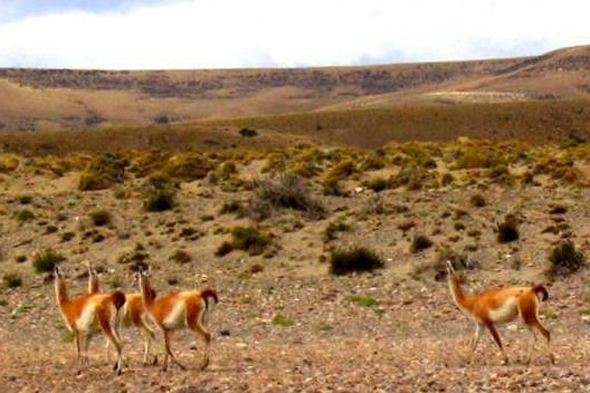
14 Jan., 1834 – San Julián – "I went for a walk and found interesting fossils" . «The guanaco can drink salty water. They are seen in quantity »
We leave Puerto Deseado and head south, on a journey through time, following the path that Darwin traveled in 1834. When you reach San Julián, visit the replica of the Nao Victoria, used Magellan on his return to the world and we will learn the history of their passage through this place where nearly lost his life. We will approach the grave of Lieutenant Sholl, that was part of the first expedition of the Beagle. Also see the hill Monte Cristo, where Magellan placed a cross and where the first mass was celebrated in Argentina.
After lunch drive along the coast of San Julián, where among other things we will see Punta Quilla, where they repaired the Beagle around Fitz Roy and whose toured Darwin to collect information for its naturalistic studies. With the famous engraving of the ship beached will find that it is exactly the same place. The more daring can climb the 70 meters of the gorge for a majestic view of the estuary. Night at the Waterfront Hotel.
Day 8 – Santa Cruz River Estuary
16 Jan., 1834 – Estuary of Santa Cruz – «The ship was grounded on the coast. No other place could have been more favorable to carry out this operation »
Visit the Monte Leon National Park, the first coastal national park Argentina, whose strange formations are home to a variety of wildlife, including guanacos elusive.
Afternoon, San Julián back we stop at the village of Piedra. On the island Pavón, on the Santa Cruz River, Darwin camps as part of su exploration of this river. Addition, in this place was established the commander Luis Piedra, thus achieving sovereignty sustain Argentina in this remote region. In a replica of their home lies a small museum.
Day 9 – San Julian El Calafate Patagonia Steppe
18 April, 1834 – Santa Cruz River – "The water is a slightly milky sky blue color. However, it is not as transparent as one would expect »
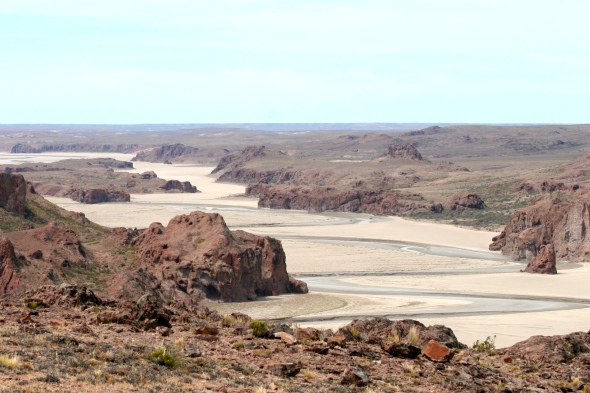
We leave the coast of Patagonia to enter their steppe. We will take the Provincial Route 9 that, from above, runs beside the meandering river Santa Cruz, that was explored by Darwin and Fitz Roy in April 1834. In many ways we see its meanders and, if time permits, go down to the coast in between. Around noon we arrive at Calafate where we stay in the Kau Yatun Hotel.
Then depart for an important milestone Darwin travel through Patagonia. If conditions permit, a group can make navigation on the river following the voyage of the Beagle. After, depart for the nearby El Calafate.
Noche en el Kau Yatun Hotel.
Day 10 – Perito Moreno Glacier
4 May, 1834 – Santa Cruz – «We say goodbye to the Cordillera, which probably, at this point, never seen by another European »
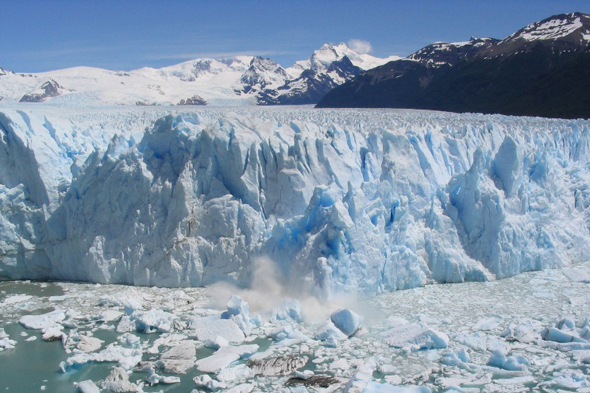
Finally came the most awaited day for most. Depending on what travelers can decide early to visit the glacier Perito Moreno before the tour buses arrive in the morning or visit the Glaciarium, the first thematic museum devoted entirely to Argentina's glaciers and ice, to rest from the long day the day before, and approach the Perito after eating, to enjoy the evening light (If the weather) and the magic of the place when tourists depart.
In any case, Calafate depart west across steppe habitat along the Lago Argentino. As we approach the southern arm of the lake will notice a change in vegetation and, immediately, to enter the Glacier National Park, will have left the steppe to meet in the Andean forest. Before reaching the gateways have the opportunity to see the Perito Moreno glacier from afar and ice fields behind him. On the catwalks we stay a long time admiring this wonder of nature and celebrating each ice shedding.
If we visited the Perito morning, after eating those who wish may make a walk on the glacier which also involves a small sail to the other side of the lake (excursion not included).
Noche en el Kau Yatun Hotel.
Day 11 – El Calafate-Buenos Aires
Day at leisure until transfer to airport for flight to Buenos Aires and connect with the flight to Spain.
Price per person sharing a double room:
Based on 10 passengers: 2.250 EUR
Based on 12 passengers: 2.162 EUR
Based on 14 passengers: 2.071 EUR
Based on 16 passengers: 1.987 EUR
Based on 18 passengers: 1.973 EUR
Based on 20 passengers: 1.937 EUR
Supplement single room 417 EUR
Land route prices include:
Accommodation in the mentioned hotels with breakfast and taxes.
Private services (with exclusive vehicle for the group) navigations except in Puerto Deseado (when the group is less than 14 passengers).
Tickets en ferry a Colonia y Carmelo.
Support local guides and local expert on Darwin.
Entrances to National Parks and Museums: Museums in Cologne, Tickets Museums in Puerto Deseado, Glacier National Park Entrance (El Calafate), Glaciarium entry.
Meals (welcome) to drink – 1 water or soda per person.
These prices do not include:
-Air fares from the place of origin (travelers who want the be managed by Eland Expeditions) and both internal flights. Approximate cost flights Buenos Aires, Comodoro Rivadavia and Buenos Aires El Calafate: 505 EUR. This amount includes local taxes and airport fees out of Buenos Aires; the departure airport tax of El Calafate is payable locally (8 $ about).
-Meals and drinks (except those indicated in the itinerary). Should calculate a budget 20 euros per meal.
-Personal expenses and extras.
-Tips to porters and drivers and guides to.
More:
info@elandexpediciones.es
Telephone: 91 8521487