


The trip


San Sebastian welcomed me with cold and rain, as it endeavored to recall dark days of last su. After the City, a magnificent Belle Epoque building 1887 that its past elegance and casino chairs Alderdi-Eder Gardens, starts the call Parte Vieja. They are pedestrian, low-rise buildings, stone facades, wrought iron balconies and yet, after the chapter he wanted to revive. Year 1813, French in full retreat, when the Revolutionary War comes to an end, a French general is entrenched in San Sebastian 2.600 soldiers. The city gates are closed and the epidemic which spread fear among the population. As I passed who enjoyed Sunday morning with a newspaper under his arm, children who did not lose a puddle and moviegoers who knew the city during its film festival thought the experiences of his countrymen in times of political turmoil and military. Donostiarras feelings towards the invader were observed in 1808, when Joseph Bonaparte on the way to Madrid to take possession of the Crown passes through the city and the public responds by closing the windows as it passes through what is now the street Narrica.
Walking down Main Street came to the Church of Santa Maria, I crossed to the Plaza of the Constitution, built after the fire of 1813 and who once also houses the town hall was bullring, made by colorful facades that are balconies numbered. The story begins to take shape a few streets away. I found the street 31 August, whose facades still whisper nightmares of fire and looting. That day 1813, Allied troops consisting of British and Portuguese soldiers launched the final assault on San Sebastian. The French army could not stand the onslaught and retreated to the Castillo de la Mota, a twelfth-century fortress expanded and enhanced through the ages. That morning the street breathed peace and quiet, only a handful of passers-by without thinking roamed the horror lived two centuries. The release was not such, since the military sacked tirelessly for six days, raping and murdering, and caused several fires that burned down the city. Just up the street was the Trinidad, conmemorativamente street today 31 August, where they had established their residences Allied officers. Walked abstracted, recalling those events, despair imagining the 3.000 who died at the hands of their liberators.
The release was not such, since the military sacked tirelessly for six days, raping and murdering, and caused several fires that burned down the city
The rain did not let up in its efforts to stop but he had another appointment to meet. Born in the port area stairs begin the road to the Castillo de la Mota. The path through the woods Urgull gave me priceless views of the city, fishermen with their fishing in the harbor, moored boats and the island of Santa Clara imperturbable witness. Some of these viewpoints are located in ancient cannons lines, battery as Governor, willing to defend the fortress against the enemy. One of my stops was the so-called "English Cemetery", one small-sized cemetery pays homage to the fallen British in a subsequent Carlist siege to the fortress. While epitaphs read the name and thought of many who left their lives away from home, in struggles that ignored its purpose, the case had, stocks cut by the sword of power, forgotten while devouring their tombstones vegetation.
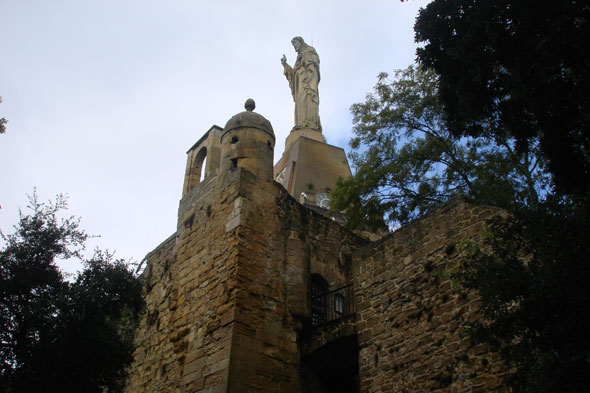
The top is crowned Urgull the Castillo de la Mota, the place where the French troops surrendered the 8 September. It was built by order of the King of Navarre, Sancho the Great and her latest dating makeover 1950 when installed atop a huge picture of the Sacred Heart visible from across the city. It now houses an interesting exhibition "Looking to San Sebastián" that brings us to the history of San Sebastian. I found an interesting example for those who like to know the past of the places visited.
Slowly made my way back. One never ceases to marvel at so many events that have shaped our cities and their inhabitants, giving rise to what we now know. Back in the Old, I looked out the bars with its endless bars filled with a thousand and one pintxos. I realized it was time to savor and enjoy this donostiarra.
Eduardo De Winter
www.blog.infoviajero.es
info@infoviajero.es
The road
The easiest way to travel to San Sebastian probably be in car or bus. The city has an airport but it is located in Hondarribia about 20 km.
A table set
-There are many notable bars in the Old dara enjoy traditional pintxos. Among the more classic, simple and find the best price Mejillonera. Located in Puerto, 15 This restaurant offers tapas of mussels in various styles and fantastic patatas bravas. On the same street Puerto, but the number 8 escontramos the Bar Portaletas, another traditional event for the San Sebastian where hopefully we can get a table and enjoy the varieties of pintxos that offer.
-Münstergasse street is full of small restaurants in the arcades with reasonable price and menu option to medioía.
Highly Recommended
-The ideal is to make the journey described a Sunday morning, to end pintxos enjoying the atmosphere of the Old Town at noon. This is the moment when he takes the pulse of the city and its gastronomic life, at least in terms refers tapeo.


