






The plane should not have been more than 1.000 meters. From the window, a tongue of land ended in a small cluster of flashing lights. I had already saved the reading that had occupied me on the jump from Atlanta to Kingston – two hours by plane, or there–, 'The cup of gold', a fictionalized biography of Henry Morgan, the most famous pirate in the Caribbean. And that piece of land that was reborn after a strip of asphalt finally turned out to be Port Royal, the ancient capital of Jamaica and where the pirate Morgan – first as a buccaneer and then as a governor – built his legend.
Jamaica is a small speck of land in the Caribbean Sea; something like an island with the surface of Asturias and a story halfway between glory and hell: Port Royal It was known as the “most corrupt city in the world”. So when an earthquake shook the earth in 1692 and swallowed the city, The interpretation was that of a divine punishment –perhaps deserved–. The survivors moved and founded Kingston, at a very short distance.
A Port Royal, former capital of Jamaica, the pirate Morgan created his legend
The capital of Jamaica is today an anarchic city: a mix of that maritime tradition and a culture – and blood – of Africa pumping in their veins, since during the English colonization more than a million slaves arrived to these shores. If this composition occurs under the tropical sun and is surrounded by the Caribbean Sea, We understand what this small island that the Tainos called 'Xaymaca' means. (land of wool and water). Now, the 92% of the Jamaican population is of African descent.
"In between 1962 and today many things have changed, but we could have done a lot more if we had some kind of development plan to fix a lot of things: “Governments have struggled to ensure facilities.”, comments Vereen Shepherd, president of the National Reparation Commission that the Government created to articulate the demands to the United Kingdom, its ancient metropolis.
Kingston is today an anarchic city, with the blood of Africa pumping in the veins of its maritime tradition
As in all Caribbean countries – a list led by Barbados –, Jamaica was a plantation society: The immense sugar mills that still blow the wind along the roadside today created a physical and imaginary landscape that collapsed when slavery was abolished in 1833 after the countless uprisings of the slaves of this island. It is not strange that all national heroes, that there are seven, are related to the liberation of black people.
“The commission listens to different voices to see how affected groups think about the justification for reparation”, it is about listening to “personal experiences of how they have disconnected from their history and their suffering.”, explains the professor in her office at the University of the East Indies (UWI) on a rainy October afternoon.
As chance would have it, this trip along the edges of the island, with some incursion into the navel of the jungle, coincided with the celebration of National Heroes Day, the 19 October. and that the day 12 October, Hispanic Heritage Day, find me interviewing Shepherd, a woman who is also part of the United Nations Committee Against Racial Discrimination. A woman, thought, temperate and reflective, with an institutional profile. So, after almost an hour of conversation and to satisfy personal curiosity more than any other interest, I asked him:
–And what do you think of the 12 October?
–Spain colonized Jamaica and practically killed the indigenous people. We, in this part of the world, We cannot understand why Europeans have no responsibility for their actions.
Donovan Germain, one of the most important producers on the island, confirmed to me that reggae fever is on the decline
Many of Jamaica's political movements, in fact, have gone in search of recognition from the United Kingdom that does not come: They recognize that the slave trade was something historical, but they have no responsibility.
But far from complacency, life in Jamaica vibrates: vibrates in the streets, in music venues, market, in the musical notes that are exported to the entire world. Since Bob Marley emerged from its glorious Trench Town – a colorful neighborhood of parallel streets in Kingston –, Reggae has been the most characteristic anthem of the Caribbean country.
Donovan Germain, one of the most important producers on the island, He confirmed to me that the reggae fever is on the decline and that young people prefer to listen to much harder mixes on the radio.. The day I met Germain at his studies Pent House It coincided that the duo went to visit him Althea & Donna, who had triumphed – apparently – in the years 70 in England with the song 'Uptown Top Ranking'. Does the song sound familiar to you?, the producer told me in front of them. I showed a surprised face, so they put it on the computer and, when he asked again, my educated – and cynical – side exclaimed “of course!”. I don't know if they believed it, because he immediately told me: “Interview them”. And, obviously, I didn't think of what to ask them, so I resorted to obvious.
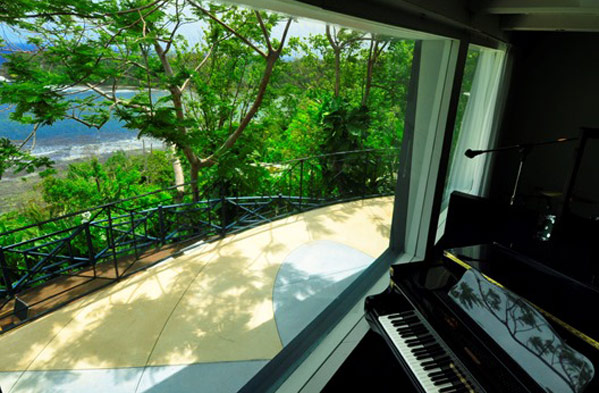
The Geejam Hotel has one of the most universal recording studios in Jamaica
A 100 kilometers from Kingston is the Geejam Hotel, which also has one of the most universal recording studios in Jamaica: In this village of small houses scattered among the tropical flora, Alicia Keys has recorded albums, Björk, Katy Perry o Amy Winehouse, among other stars. Port Antonio It was the place chosen by producer Jon Baker to create the ideal place where music emerges beyond the capital. And it is not strange that this hotel and studios perched at the heights, with privileged views of the sea, be the workplace of those who come looking for inspiration.
It is precisely on the north coast where tourists drop by. Port Antonio is the most coveted place, although more expensive and where the stunning boutiques – such as the Geejam or the Trident Hotel – accommodate their clients. But the bursts of hotels follow one another all along the coast: Eight rivers, Montego Bay and Negril – with a long sand ditch overturned into the sea – are the best-known places, common and accessible to all economies.
Alicia Keys has recorded albums here, Björk, Katy Perry o Amy Winehouse, among other stars
The true interest in the history of Jamaica has been decided in places that are between both and to which hardly any visitors come.. In the depths of the island, a mountain range known as the Blue Mountains It served the rebellious slaves to hide and fight against the colonial power... And Falmouth, eg, It was an old city that emerged thanks to slavery and the sugar industry, but the cruise ships that hop between the Caribbean islands barely stop. It is likely that the mockery of four centuries of dominion goes unnoticed by the occasional visitors who visit the island., who ignore that among the restored streets of this beautiful city people were traded. Everything is written about tourism.


