



The huge canoes approached the beach. Decision and emotion, of one of them descended a big man: After Matu’a. His people sang with joy while he, Taking a handful of sand, With a cry ended almost two months of dangerous and uncertain navigation. They had reached a new land.
Thus I imagined the landing of the first residents of Rapa Nui, The mythical Easter Island, While walking through the beautiful beach of Though. We had arrived the day before looking for sun and rest, but that was stronger than our desire to understand the intriguing past of this enigmatic island. And it was Anakena the place where this story began with the arrival of the first Ariki, or king, about a thousand years ago.
Anakena was the place where this story began with the arrival of the first Ariki
"Ioran", They greeted us and welcomed us with a flower necklace upon arrival after more than four hours of flight from Santiago de Chile. Of course this trip was nothing compared to the incredible journey of Hotu Matu'a from somewhere in Polynesia. The people of the Pacific could sail, in their canoes, extreme distances guided by the stars, clouds and the flight of birds. This is how they managed to populate remote islands thousands and thousands of kilometers away from each other, like Hawaii., New Zealand, Tahiti and many others. But without a doubt, his arrival to Easter Island made up the most incredible trip to this surprising town.. This very long journey full of risks and dangers was the first challenge that the town had to overcome Great rubber.
Already in the small complex of cabins where we would stay for five days, they showed us a map with the location of the places of interest and how to get to each of them.; but my head imagined the early days of Hotu Matu'a and his small group of people. Knowing how isolated their position was, they called their island Te pito or te henua, which means “the navel of the world.”. At that time the island was entirely covered by palm trees and bushes.. There was not a single mammal on it., Ni Reptil, nor amphibian, but in the crystalline waters that surrounded it they found a rich variety and quantity of fish. This added to the chickens, tubers and other plants that travelers brought in their canoes, guaranteed them a comfortable survival.
My head imagined the early days of Hotu Matu'a and his small group of people
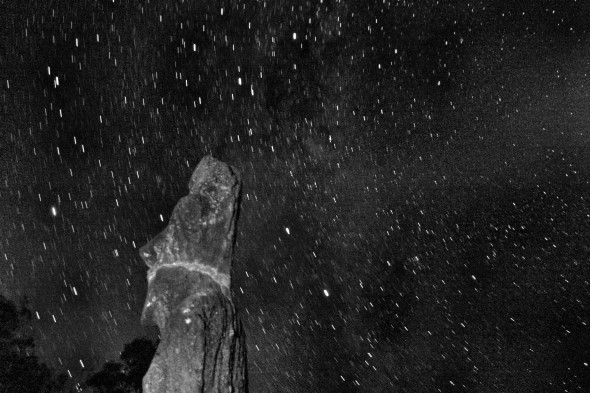
It was getting dark and we decided to walk Tahai, where you can see the sun setting behind nice, those huge stone monuments that made this island famous. We carry cameras and tripod, but no photo could capture the true magic of the place and the moment. But... What are those moles?? What do they mean? Throughout Polynesia the great figures of its past were venerated. In New Zealand, eg, Human figures were carved in wood standing with their hands next to their bellies., in the same position as the moais that we had in front of us. But how did the Rapa Nui carve them?, and how they transported them?
We had the answer the next day, when we passed by the interesting Anthropological Museum and then visited the Volcán Rano Raraku where these stone masses were sculpted. The people of Hotu Matu'a multiplied and populated the entire island and maintained the tradition of carving figures representing the ancestors but they took it to a higher level by making them in stone and larger in size..
No photo could capture the true magic of the place. What are those moles? What do they mean?
In the volcano quarry you can see one of the first moais, human height and rounded features, similar to New Zealand figures. But over time the sculptors increased the size of their works and their facial features changed.; They became straight and prominent eyebrows. On the wall of the volcano there are several moais sculpted in the rock without finishing. Initially they carved on the same wall of the mountain hitting with tougher stones to then be lowered to their foot, cracked into trunks and sustained with natural fiber ropes. The work should be dangerous since there are several that were fallen.
The Paseo on the quarry continued between, literally, Hundreds of Moais Semantrados on the soft floor. There they were polished and perfected prior to the most difficult step: its transport to the site where they would definitely stand. How did they do that? Here studies coincide with oral tradition, who says that the Moais "walked" on the island. But how, if they weighed more than twenty tons? It is believed that the Rapa Nui swung them just as one would move a tall refrigerator.. For this they tied ropes to his head, which explains the reason for those enormous eye sockets and marked eyebrows; They were necessary to tie the ropes there that were used to swing it from one side to the other. Its base was rounded, designed to help this movement.
The Paseo on the quarry continued between, literally, Hundreds of Moais Semantrados on the soft floor
The next day we woke up before dawn to arrive at the ceremonial site of South Africa and watch the sun rise behind a row of fifteen of these sculptures. There, In the dark we heard people from all over the world. Tourists who, assortments of cameras and cell phones, They were preparing to enjoy and portray that unforgettable ancestral experience..
To achieve the ahu or ceremonial platforms where they were installed, some moais had to be transported more than fifteen kilometers over broken terrain. Now, following the paths used in ancient times, several of these sculptures are found lying, which shows that transportation did not always go well. If they fell it was impossible to get them up., so they were abandoned. To get an idea of ??the difficulty of constructing and carrying each of these masses to their place of erection, it is enough to take into account the following numbers: Over several centuries the Rapa Nui built almost 900 moais but “only” 300 they arrived at their destination. Two thirds were left in the quarry or scattered along the roads..
The almost tropical sun took away our energy, so we alternated visits to archaeological sites with dips in the sea
Although the weather is not hot, the almost tropical sun took away our energy, so we alternated visits to archaeological sites with dips in the sea, where we took the opportunity to do some snorkelling, enjoying the rich and varied underwater life.. Of course, at night we accompanied a fish dish with the inevitable Chilean-Peruvian drink “Pisco Sour” in any of its colorful local versions..
Sometime around the 16th century the construction of the statues stopped abruptly.. Why? What happened?
The Rapa Nui faced their second challenge: overpopulation. The island's resources were consumed
Studies indicate that the population grew to exceed ten thousand inhabitants, double the current. This is how the Rapa Nui faced their second challenge: overpopulation. The island's resources were consumed. The water and arable surface were not enough and the trees disappeared. Without the possibility of making canoes, the Rapa Nui were prisoners of their land.. The war between tribes devastated the island. In caves there are cave paintings that document the horror of those times when hunger would have given way to cannibalism. Among so much barbarity, knocking down the moai of enemies was a very common action and thus, little by little, they all lay down.
When the Dutchman Jakob Roggeveen sighted the island on Easter Sunday 1722 there were still statues standing but, from what he understood of the islanders, His belief system had changed a lot.. “Birdman” reigned.


