


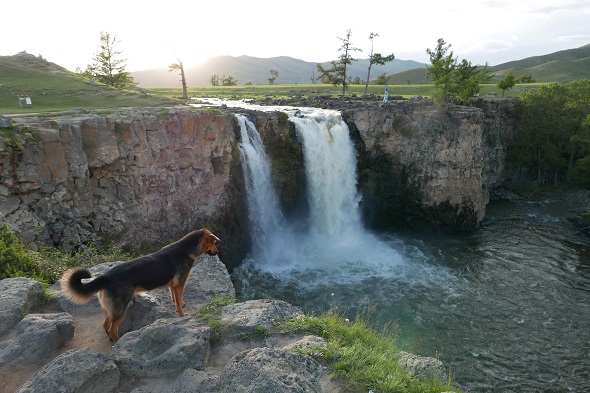


Mongolia is peace, silence, stars, Plains, extremes, quiet floors, muddy roads, forests, reddish cannons and giant dunes. Mongolia is immense nature and the coexistence of man with her equal to equal. A trip to the past, When we were a more perfectly fitted animal in the ecosystem puzzle. Traveling to the world less populated in the world helps to understand how you can live looking into the eye to Mother Earth.
Mongolia is really that, The man and the earth, With what entails for the traveler. You have to forget about hot water, of daily shower, of the asphalt, of soft mattresses and bathrooms as we know them. Also to look in the mirror and, especially, of the clock. Life spends in Mongolia, It happens quietly and connects with our roots.
You have to forget about hot water, of daily shower, of the asphalt, of soft mattresses and bathrooms
The first impression, night, from the air, It is already revealing. The thick blackness lets a country guess with few people and less electricity. Some weak light, here and there, until you reach Ulan Bator, where half of the population lives. Not even this city of a million and a half inhabitants looks like any other capital. Extends in a valley, It has the dubious honor of being the coldest capital in the world with temperatures of up to 40 degrees below zero in winter and consists of a mixture of Soviet buildings, other more modern "condos" and yurts scattered here and there.
Is yurts, Those Round Base Stores of the Mongolian Culture, They make up whole neighborhoods on the outskirts mixed with houses of a plant and also generate the main problem of Ulán Bator: pollution. They heat up with a stove housed in the center that feeds on coal, A cheap heat source in a country with a GDP per capita similar to Sri Lanka or South Africa. His smoke is stagnating in the valley, especially in winter, When the lack of wind does not help to disperse it. Ulán Bator is practically the only paved population in the country and, Although bustling and somewhat chaotic, It does not reach the level of other Asian capitals. Even the big city is quieter in Mongolia.
Ulán Bator has the doubtful honor of being the coldest capital in the world with temperatures of up to 40 degrees below zero in winter
There are few roads. Except the main routes, that can be done by bus, You have to hire an organized trip or an SUV driver. Only the most experts can venture to rent one and go on their own, And then have a good GPS, find out the busy routes, Know of mechanics and carry utensils to get out of mud. That if you travel in summer, The rainy season and the warmest, in which you have to count on running at any time in the middle of the desert. And is that Mongolia is wild, And it is from the first kilometers when leaving Ulán Bator, When you have to say goodbye to civilization and welcome that immense natural park that is this country embedded between Russia and China.
We made a twelve -day route for the Gobi desert y Mongolia central. Seven tourists, a guide and the driver in a Russian van four for four. I clearly remember the first stop, about 10 kilometers from the capital, To buy food. It was my first experience with the Mongols bathrooms. Letrinas, that are scattered throughout the country a few meters from the yurts, There are four (Sometimes three) wooden walls and a hole in the floor flanked by planks. And in rural Mongolia there is no current water, No electricity, nor mobile coverage. You live in Yurtas that, In the case of nomadic families, They move from one place to another twice a year looking for grass.
Mongolia is wild, And it is from the first kilometers when leaving Ulán Bator, When you have to say goodbye to civilization
You have to forget the concept of private property, Anyone can plant their house practically anywhere. Because there are no fences or walls that delimit some without cultivating fields. Everything belongs to everyone, And everyone enters animals. Horses, cows, yaks, goats, sheep and camels past, In a symbiotic relationship with the Mongols. Animals depend on them to eat in winter and, return, They feed them. From milk the Mongols get the cream and yogurt, They dry for winter. The meat also dehydrates it to pass the cold months and the skins use them to isolate the yurts. They are so important that the Mongol has a different word to name the feces of the different animals.
I traveled to Mongolia to look into the eyes of those people who lives 40 degrees below zero in the middle of the plain, those people who have so little attachment to things that changes your home site every six months. And I found many smiles in those scarled and little curious eyes, With looks of pride of tribe and humility, of concern to make the other at ease. In bodies spent by the life of the field, small but incredibly strong, With a brilliant coffee with milk cracked by the sun. The attachment? They have it. To his immense skies, To Earth, To the animals that feed and the sun that dominates the vast majority of their days.


