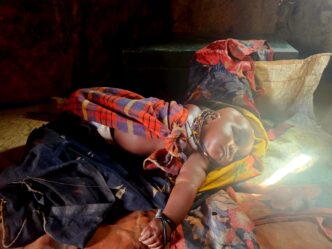
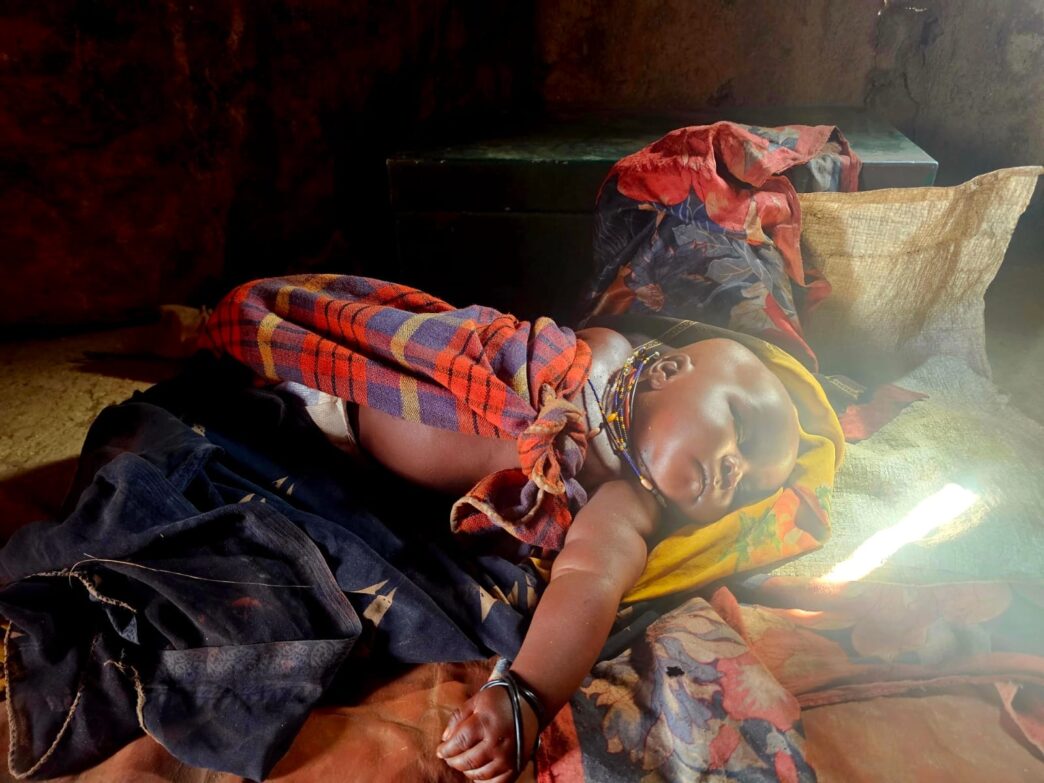
A baby lies on the floor of a hut next to a box with a padlock. Sleep on fabrics and skins. Back, in the chest, The chief keeps documents and the money that the Namibian Government gives to each elder in the village. It is a distant village. This year we have made some 40 kilometers of cobblestone and sand road, on the difficult path between Epupa and Ruacana, a road closed many times due to the flooding of the Kunene River, to look for something more authentic.
What is authentic? Do we confuse authenticity with poverty, lack of development, lack of contact with people like us…? I've been asking myself that question for many years.; I haven't responded for years. But we look for that, and this town so far from everything seems more authentic to us. We are satisfied.
I began visiting and writing about the Himba in 2010. Every time you learn something new from them. This time Samuel, my himba friend, He explains to me that there is a great boss, a kind of monarch in this area of Kaokoland. I thought the towns had autonomy, But in the complicated Himba system of marriages and dynastic lines it turns out that there is someone who has power over them all.. Order is a human need, power is a vice. The human essence is the same here as in the 5 New York Avenue.
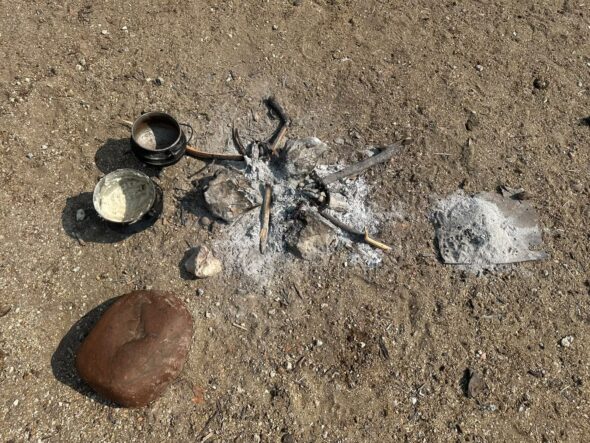
The leader is an old man. The Himbas, the indigenous people in general that I have met around the globe, They see wisdom in old age and pay tribute to it. The authorities do it too. Pagan 1600 namibian dollars (85 EUR) per month to all those who exceed the 60 years. And 350 (19 EUR) to the children between 2 and 18 years. With the children, we wait for them to survive to register them, to disburse the money on a living person and not on a dead person.
In Mozambique They wait until they are five years old to name them and baptize them in remote areas.. Baptism costs resources, registering them means going to the city, an investment, and we wait to know that they last so that it is profitable to do so.. It is impressive to see graves without letters. The nameless called them. Corpses without time of appellation.
Age is another fiction for the Himbas. “We don't know when we are born. It is calculated with ideas such as the year it rained a lot, or the time that cattle died… I don't have a birthday, "I don't know the exact day I was born.", explains Samuel.
The nameless called them. Corpses without time of appellation.
Now that has changed. They need a document to receive a pension. So they go to Opuwo, that is very far away, it's another planet, three hours by car, and are recorded by eye. The elderly and children receive the money that is in the locked box next to the baby.
Outside of that hut, the town is similar to many that I visited before., but further from the contamination of progress. No cars pass there., we don't go there, and we don't want to bump into people like us, Turistas, on trips. Out there are our vehicles parked and alone. We like that. Do you understand the irony?
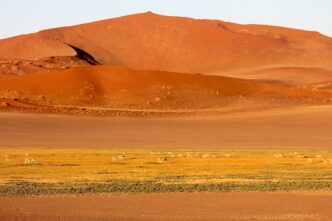
There is no electricity or water. Huts in a circle, a corral for the animals in the center, and a desert in which to survive. Do you already use the bathrooms?, we asked Samuel jokingly. And he laughs and says “nooooo”.
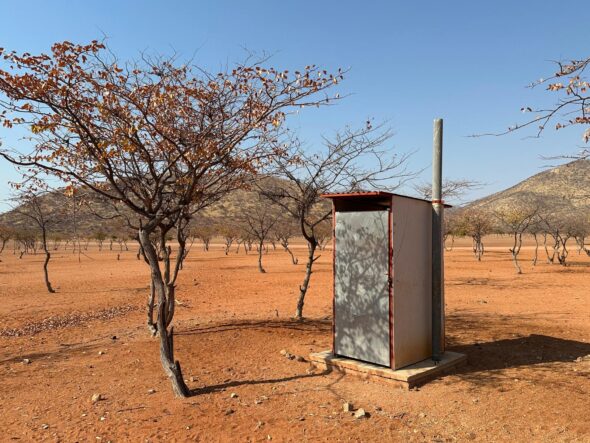
Two years ago I visited with him a village where they had built a toilet, with its closed door and its septic tank. It was a strange tin cubicle in the middle of the desert. “They came from the government to install that toilet. Nobody uses it. It smells terrible in there. We are going to do our needs in nature, but they told us that this was good for fighting cholera”, Samuel told me with the acquiescence of Chief Chikoko, who looked at that room with the reluctance with which the Himbas see that world that is foreign to them and in which someone decides that helping them means spending a lot of money on stinking latrines for a town whose bathroom is an immense desert..
In the town we are in now, the bathrooms did not arrive., even for that they are very far away. We walk and talk among the women and men of the village. We have brought them food. That suits them very well. And we are also an entertainment in their eternal routine that is often only appeased by alcohol.
Do they want to ask us something??, I ask Samuel to translate for them. So that there is some exchange, so that it is not just us who ask them. So different are they to us?, like us for them. I learned years ago that they think we smell bad., strong, down… I was surprised. I never thought that my showered and deodorant self could smell bad.. Our clothes smell bad. Their cattle do not allow themselves to be milked by people dressed as Westerners. I smell bad in a town where women never wash with water and only rub incense all over their bodies..
The question they should ask us remains suspended in the air for a while.. There is a silence and at the end comes the doubt: “Why do you take photos?”?
The question they should ask us remains suspended in the air for a while.. There is a silence and at the end comes the doubt: “Why do you take photos?”?
I walk outside the compound and look for a moment at the shacks and the wooden fence from afar.. It's another planet. We have been in Namibia for a few weeks and we feel out of our world. That's why we come here. The omnipresent Trump does not exist, nor Iran, nor does anyone know anything about Ukraine, nor of Chinese electric cars, nor that the price of fuel and electricity went up, nor that Pedro thinks about calling elections...
Years ago, in March 2021, I left a Rome with a curfew due to the virus and a few weeks later some Himbas in Cataratas Epupa told us that some people from the Government came to talk to them about an illness. They didn't know what it was.
There is a foreign world, who lives without knowing anything about others, to which we do not pay attention. The UN points out that there are 476 million indigenous people in the world who live in 90 countries. They are the 6,2 percent of the world population, but they represent the 15% of the total of the most disadvantaged on the planet.

They have land, many, but vacant or far enough from amenities to allow them to continue in them. The UN assures that they are “owners of the 28% of the planet's surface and 11% of its forests. deserts, ice and jungles of which they are stripped when riches appear in their bowels.
Their culture is threatened by the tsunami of technology and development. “They go down to the cities and when they return they listen to other music, "They dress differently and no longer want to follow our customs.", Alejandro Hernández once told me, Rarámuri chief of the Papajichi community, in Mexico.
I have heard a very similar message in other indigenous communities throughout the globe.. Are we going to end the indigenous world from an iPhone? Among the Himbas there are chiefs who bet on putting rubber in their sandals, use fanny packs, allow more children to go to schools, use non-traditional daggers... And others who think that this sacrilege will end their customs. Every tribal village faces the same challenge.
Doesn't seem badly treated, At least she does not seem to be treated worse than the rest of the children in a very primitive village with obvious signs of poverty.
In a Hakaona community, another tribe from northern Namibia that comes from neighboring Angola (These borders are fictitious for people who have been crossing the Kunene River for centuries and wandering through a single homeland that delimits the desert and the rains.), There is a girl with bent feet and clear signs of severe intellectual disability.. It is lying on the ground, next to a hut, surrounded by other children and women. Doesn't seem badly treated, At least she does not seem to be treated worse than the rest of the children in a very primitive village with obvious signs of poverty.. They take care of her without taking care of her, how everyone takes care of themselves there.
Javier Colomo, a traveling companion, He approaches and gains his trust while cleaning his face full of snot and drool.. She smiles, he protects her. Another Javier, an artist, Hi Naphula is his name on stage, He plays and sings with all the excited children of the town who follow his dances and clapping.. Maite touches a young woman's arm and she touches hers in turn. They speak with the language of the world that has too many words. They talk touching each other. Manu contemplates the scene with the same respect with which he crossed the globe. It's not a pose, it's an engine. María and Gemma wander between the huts with the key to being empathetic and not having complexes. Aritz takes a photo and absorbs, because he always absorbs everything and then dialogues with himself in his notebooks at night. Ivan is worried about delivering some sweets he brought to the children.. Fuck, again we come to Namibia with a fantastic group. we are lucky.
The Hakaona look quite similar to the Himbas.. They come from the same common trunk. Their living conditions are almost the same.: Poverty, lack of development, substandard housing, technological lag, and a life with other forms and customs. ¿They are happy? I do not know, I never asked them that. He also didn't ask the people I bump into here in New York where I now live.. Why should I ask that of some indigenous people??
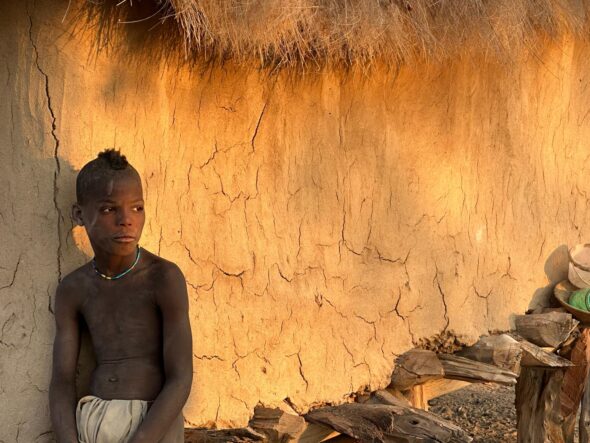
We also bring food to the hakaona. We also leave our mark with our fleeting step. We are also leaving.
That night during dinner a conversation occurs between us. We are a group of ten people, all spanish. We all express concern for that indigenous world that we have been contemplating for days and that we understand is at risk of disappearing.. In Opuwo he is a himbas, herero, hakaonas… drunk, beggars, misfits of a society where their norms and beliefs do not matter. exist, but they don't matter. And others work, They dressed in non-traditional clothes, and they return to their homes with their families and their solar panels. Nomadic people trapped in an arid city. In Windhoek they sold souvenirs in markets, just like they do in Swakopmund.
And in between those cities we stumble upon that indigenous world among the thousands of kilometers of empty Namibian roads.. They go out onto the roads when they see cars approaching. The image repeats and repeats: a body that extends an arm. They beg from a car that goes at full speed and I suspect that it almost never stops. A body in front of a town in the middle of nowhere that rushes to run to ask for anything from strangers. And there they stay, being a shadow in the dust of a rearview mirror with his hand raised.
And we want to protect that world. The indigenous free world that knows nothing about the US elections, who doesn't know who Putin is, the most popular television program in your country, 5G, or the use of clocks and calendars. Would anyone want someone they love to live here in one of those towns and under those customs??, we debate at dinner.
And that whole group of people concerned about maintaining those towns and customs responds: “No”.
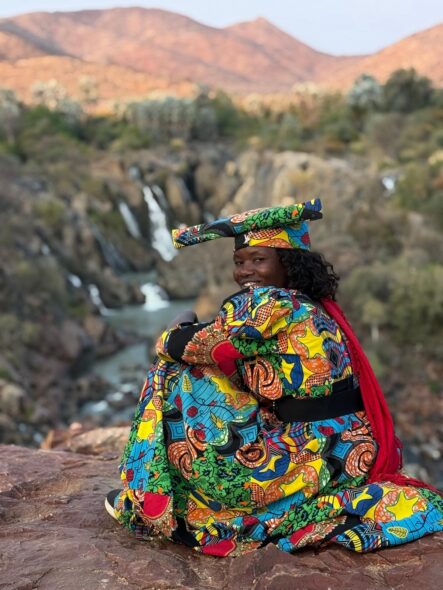
This text has been published in part in the newspaper El Confidencial. The author, Javier Brandoli, He is the director along with Daniel Landa of the Viajes al Pasado agency. The photos are authored by some of the travelers who came to the route of 2026 for Namibia. In April 2027 there will be a new route. We not only see, we debate what we see…