





While we were leaving Soria through the Cintora plain, through which the Duero, listening to stories of the autumn rut, I was thinking about the last electricity bill and the possibilities, increasingly less uncertain, of surviving on candlesticks and gas camping stoves. We were heading to Numantia, the peninsular sublimation of the resistance, the mirror where anyone who wants to learn how to not give in to the onslaughts of life must look at themselves. The successive gorings of the economy should have long ago turned Numancia into a theme park with a non-negotiable slogan: «Lessons from the crisis». No more.
I, at least, I went to the vestiges of the heroic Celtiberian city ready to soak up that pedagogy of suffering so necessary for the daily administration of setbacks and blows.. In these cases, you already know, It is always better to look down than up. To make matters worse, while capsizing in that tidal wave of dire omens, We were passing through the municipality of El Royo, that someone defined as the "Soriano Beverly Hills", due to the proliferation of ancestral mansions with high purchasing power. We started badly. That, More than a lesson in the face of the crisis, it was an invitation to the Euromillion.
On the way to Numancia I was thinking about the last electricity bill and the possibility of surviving on candlesticks and gas camping stoves.
Just eight kilometers from the capital, in Garray, We arrived at the hill where Numancia was located., a strategic point to see the entire plateau, by controlling the passage between the valley of the Ebro and the Alto Douro, at the confluence of the Merdancho rivers, Tera and Duero himself. The Celtiberians knew what they were doing. It is curious that the first thing that attracts attention when you set foot on land is an obelisk that is strange to the Numantine ruins., because it was erected more than a century ago, in memory of the former inhabitants of the city, with unfortunate aesthetic criteria. Someone should have the courage to demolish it and restore the ruins to prominence.
We were lucky to have an exceptional guide, Alfredo Jimeno, director of the Numantine Museum and responsible for the archaeological excavations that have taken place here since 1994. The lesson to be taught (the, at least, the one I wanted to hear) it was clear. He, also, the teacher. I had to make an effort in my role as a dedicated student..
It is curious that the first thing that attracts attention when you set foot on land is an obelisk that is strange to the Numantine ruins.
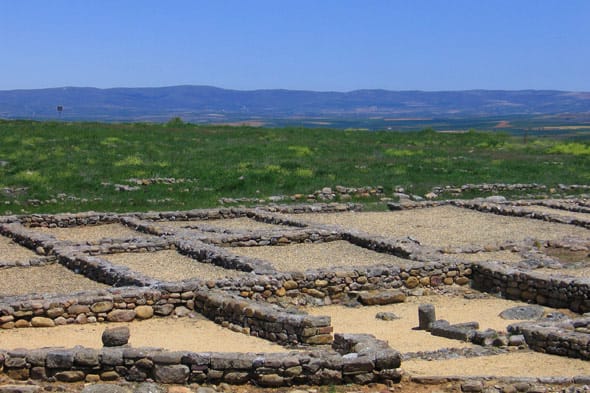
It is always a delight to listen to someone whose words resonate with passion for what they do.. One, also, waste knowledge, pleasure becomes a privilege. Jimeno combined both things and while he delved into the past of the Iberian settlement he made you walk through history. Little remains of the old city around, just the floor plan of some houses and the layout of some of its streets, but with his words he made the houses come to life, that the Celtiberians would catch their breath to walk around the town, that we could sniff out the eleven months of siege 2.147 years after.
The story is well known, but it is worth remembering it in search of some encouragement in the face of the adversity of ambushed receipts and dwindling payrolls, when not eternal and undesirable Mondays in the sun. The effort of Rome to bend, in the middle of the second Celtiberian war, to the numantine capital, home of the arevacos, emerges in the year 153 before our era. The empire takes the military campaign seriously, then he sends to the peninsula 30.00 soldiers under command Quintus Fulvius. The transalpine army, equipped even with elephants, He punctured bone and was defeated. From that point, Rome did not give up its efforts to defeat Numancia, a goal that would take him almost twenty years.
Cornelius Scipio arrived in Numantia with 60.000 soldiers to surrender a city with barely 4.000 defenders
Publius Cornelius Scipio arrived in Numancia in the autumn of the year 134 before Christ. The Senate had done the rest to achieve the objective of ending the resistance of the Arévacos. Two consular armies with 60.000 men accompanied him. In front they barely had 4.000 defenders weakened by many years of attacks and sieges. It seemed like it would be a matter of days. But.
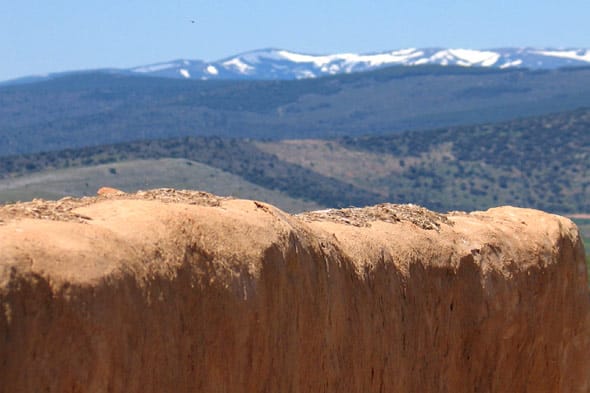
We walked through the streets of the heroic Celtiberian city (that its inhabitants oriented from east to west to protect themselves from the cold) with our guide's story intensifying the historical tension at every step. The path is crossed, from time to time, along some strips of stones that the Numantines used to cross the street without getting covered in mud. Given the orphanhood of the old homes on the site, Celtiberian and Roman houses have been reconstructed that allow the visitor to get an idea of ??how the inhabitants of Numancia lived in the more than 20 hectares that the city occupied. The foundations were made of stone and the walls, of a framework of adobe and wooden posts roofed with branches. A replica of the wall that defended Numancia has also been built, from which you can see the entire plateau that opens at your feet and, in the distance, the snowy mountains like waves of foam that surrender on the shore.
We walked through the streets of the heroic Celtiberian city with our guide's story intensifying the historical tension at every step.
The excavations have allowed us to know how the Celtiberians buried their dead: The bodies of warriors were left on the battlefield for vultures to eat., responsible for elevating your spirit to the kingdom of the gods. In the fight, their bravest enemies had their heads cut off because they thought that, thus, their qualities were attributed. In contrast, Anyone who died a natural death was cremated on a pyre with their personal belongings., some remains that later buried in a hole. "When we have obtained all the information from an excavation we cover it again", Explain our guide. Otherwise, Add, It would be impossible to keep the entire archaeological site in conditions. Spain always seems indebted to its stones.
Cornelio Escipión lifted seven camps in nearby hills (Some recognize in the distance thanks to the wise instructions of Jimeno) united by a wall of nine kilometers perimeter. It was the rope with which Rome intended to drown Numancia de Hungo and thirst. A siege that the Celtiberians managed to break once. His diet was basically composed of acorns, Vegetables and Caelia (Fermented wheat beer) and as the months progressed the provisions dwindled.
Spain always seems indebted to its stones
Despite the terrible siege, It took eleven months until, in the summer of the year 133 before our era, Numancia was subdued and devastated by the Romans. Only half of its population was still alive.. The majority of the Numantines had chosen to commit suicide. The ashes of the defeated city, their houses burned, It is the only thing that survived for more than a century until it was occupied again by the Romans. Some columns from the porch of an old Roman house, naked in front of the green sea of ??the plateau, they give faith to the victory of the empire. and to one, at that point already impregnated with the tenacity and determination of the Numantinos in the face of adversity, He is almost embarrassed to think about the electricity bill..
The visit to the ruins of Numancia is part of the route of the Train Campos de Castilla, which from May to November circulates on weekends between Madrid and Soria.


