




In the history of exploration is not rare among men and nations racing to be the first to arrive at a singular point of the planet. Often the struggle was maintained for decades, even centuries, until someone lifted the coveted trophy to have achieved what was previously unattainable.
But, has rarely been the case that two groups of men were thrown at the competition so well coordinated that seems to have been a judge who had fired the starting gun, let alone the last big challenge enfrentasen was left to : the conquest of the Pole Sur.
Much less than the last great challenge enfrentasen's remaining human on the planet: the conquest of the Pole Sur
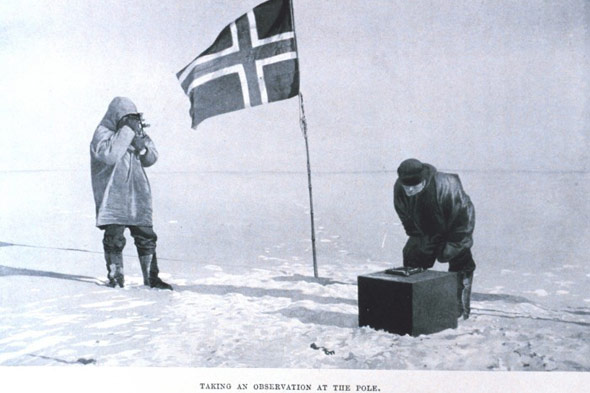
This was what happened just now made 100 years, two groups of men from different countries, cultures and preparation, led by two leaders with very different conceptions of leadership and exploration, took part in an epic duel that developed in the coldest region, desolate and barren of the known world: Antarctica.
And as in duels, it also ended sadly with the death of one of the two protagonists
A duel between those two, Amundsen y Scott, one duel against a pitiless nature would not forgive the slightest mistake and a duel against themselves, that led to the limit their ability to organize as his own physical strength against the elements. And as in duels, it also ended sadly with the death of one of the two protagonists.
The race that transcended time
While any significant event in the history of mankind has been associated with a logical impact on society, the adventure of conquering the South Pole had implied some ingredients such that, from the first moment, overflowed any forecast.
So, still unknown when the fate of Scott (news of the tragedy of the British came almost a year after the success of the Norwegian) Amundsen traveled the world into crowded receptions, while the rights to publish his book beat all records. And all this paled before the emotional impact that swept the Western world, and of course Great Britain, The fate of the Scott.
From that moment on, the views, books and studies to try to explain the reasons which led to the victory of the Norwegian and, especially, the causes of the disaster of the British. Everything has been tested again and again: clothing, Nutrition, teams, the organization, transportation methods, forms of leadership ... and even now, hundred years later, is still being discussed passionately on all these issues.
Amundsen versus Scott
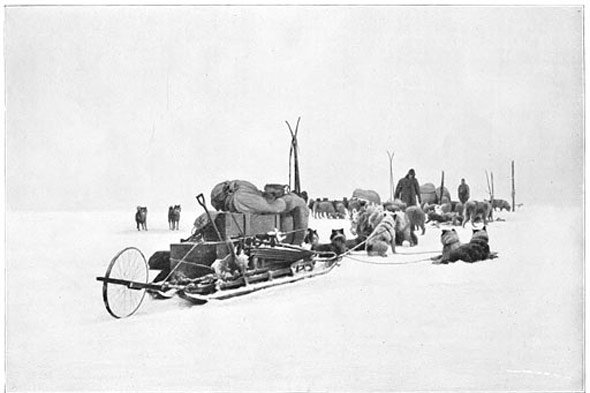
The figures of the two leaders have become antagonistic and the world is divided between supporters and followers of Scott Amundsen, accumulating each side arguments to disparage the successes of his rival. And how could it be otherwise, in this context of rivalry have multiplied the topics. So the race comes down to choosing the right method of transportation: Perras the Horses, when in the best Scott hoped to use horses rather than a quarter of the total travel.
So the race comes down to choosing the right method of transportation: Perras the Horses, when in the best Scott hoped to use horses rather than a quarter of the total travel.
Also, Scott is seen in Western man with his new technology that wants to conquer nature, while Amundsen associated with traditional methods of adaptation to the nature of man, that, while partly true, so is that Scott was in line with more traditional Western method of polar exploration: throw oneself from his sleigh, while Amundsen current art represented among the explorers who proposed the use of dogs for this task.
The last great adventure
And so, with man's intellectual arrogance of the XXI century, we, pointing-with varying success- mistakes in one or another, without realizing that as we distance ourselves from the moment when events unfolded more we move away from the possibility of understanding. So, critics often accuse him of Amundsen boundless cruelty to dogs, but clear, to an urban society like ours, where pets are almost the object of devotion, it is very hard, if not impossible, to understand the pragmatic behavior that the rural world was a century ago with the animals.
Also, for a population accustomed to the use of GPS to navigate to the streets of their city, which provides satellite communications even in the most remote place on the planet, and in case of an emergency knows he can count on the considerable resources that society makes available, we find it hard to imagine the challenge faced by those explorers.
No maps and no weather forecast is penetrated almost blindly in a world completely unknown. Without outside support depended only themselves to deal with all contingencies that will arise. No communication had to be powerless withstand the consequences of their own mistakes or bad luck, which were all.
No maps and no weather forecast is penetrated almost blindly in a world completely unknown
This is all that keeps us inexorably to its true value dimension in the feat that these men carried out and will not be repeated again until nearly half a century later and the team repeated the march to the South Pole on board did , air support to locate the best route and the ubiquity of communications kept them united to the world.
For all this, and some things, I think it was fair that those two groups of men, than a century ago faced the challenge of conquering the South Pole, deserve, although one of them lose the race, the obtaining of the glory.
Javier Cacho, scientist and writer author of «Amundsen-Scott: duel in Antarctica »


