


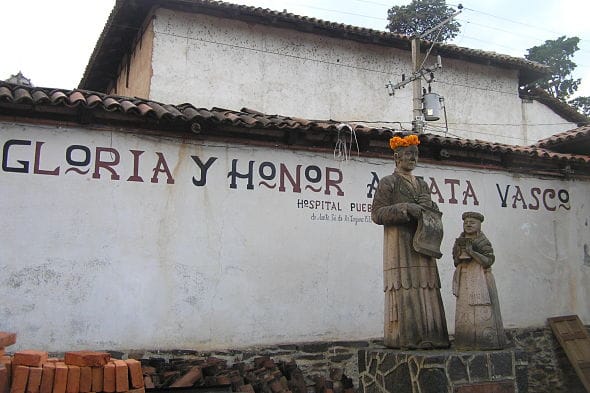
All of Michoacán carried Quiroga Basque in the heart. Wherever you go, and Tata Vasco, as the Indians called him-tata in Tarascan means father-, is here a figure of the first order, one Spanish that five centuries after his death is revered by the coexistence model that established the utopia inspired Tomás Moro. But, as often happens with many other episodes and characters of our history, in Spain is a great unknown.
And Michoacán -ground fish- There is a tourist route that is named after Don Vasco. With the map in hand, the visitor can go in a few days the people in this Spanish lawyer built his legacy, a story that begins, if you want, the day he received a letter from Queen Elizabeth in 1530. In it he intends to travel to New Spain to end abuses Nuño de Guzmán against Purepecha Indians, the people who lived in what is now the state of Michoacan.
The Tata Vasco reached the "land of fish" in 1531, when he was 64 years, imbued with humanistic spirit and evangelization of the time. Soon pacified the region and conquered the hearts of Indians. Utopia, by definition, is the unattainable, Vasco de Quiroga succeeded but touching it with the tip of your fingers. Founded truly mestizo communities and to every people he specialized in a trade (potters, copper workers, the timber, etc.), advocated a society governed by social justice in which harmonized Christianity with the indigenous religion of the Purepecha, and created the so called "huatáperas", social buildings that served as school, missionary training center, hospital and shelter. These unique architectural structures still stand as some of the towns we visit; also remains alive the system of social organization established by the Spanish and humanist ideology. Tata Vasco not repartió pieces, teaches fishing. The descendants of the Purepecha us now explain this way: "Without him, our race would have disappeared ».
Tata Vasco not repartió pieces, teaches fishing. The descendants of the Purepecha us now explain this way: "Without him, our race would have disappeared »
We started the trip where he finished his Vasco de Quiroga, in the municipality of Patzcuaro, one 54 Mexico's Magic Towns, so declared by the untouched beauty of its streets and houses. Having seen death at 93 years, the remains of Tata Vasco were deposited in a mausoleum in the Basilica which he ordered to be built in this town.
The Spanish humanist Patzcuaro made the core of his work, a community where Creole, Spanish natives and lived in peace. In our hurried ride discovered a vibrant and cheerful, urbanism with cobbled streets and rowdy portals. Our eyes return again and again to the deep red color of the walls of the houses. Patzcuaro is a must in the House of Eleven Patios. The artisans of the Purepecha region kept their shops open here, where they work and sell jewelry, textiles, toys and handmade furniture. From here, there are many religious statues every year for many churches in Mexico. All are made from cane pulp, which gives an extraordinary lightness to the piece. The technique is called "check" and it was used in the past by indigenous people to comfortably carry their gods in times of war.
In the main square we stop at a winery and make tequila collection: a bottle for the suitcase and a tweak to the stomach. The sound of the word Páztcuaro-perhaps also the "horse" of tequila that we have taken- makes the imagination is put to work collecting newly heard words. Mexico is a delicious esdrújulas populated geography as "Huatapera", «Querétaro» (chosen the most beautiful Spanish word in a vote organized by the Instituto Cervantes), «Jácuaro», "Tupátaro" or "Purépecha", and many others that we will find along the way.
And Santa Clara del Cobre, another Pueblo Magico, there 1.300 this metal goldsmiths working as their ancestors did before the conquest. With the arrival of Don Vasco and Spanish artisans, he perfected the technique of working. We stop at the workshop Casa Felicitas. From the street you can hear the rhythmic pounding of the forge. Proud here we have prepared the cauldron where the Olympic flame lit in Games 68 of Mexico. The ritual of the forge is hypnotic: four men struck with mallets copper tortilla fresh from the flames to the desired shape. No welds in any of the molded, only strength and ingenuity.
Modernity has failed to erode the customs in the village of Angahuan, where women wear traditional costumes and many families still live in "trojes", houses built with volcanic stone, adobe and wood. There are two stops on our way. The first in the church of St. James, a beautiful temple facade plateresca where we witnessed a curious scene: Simplicio, a farmer from the village, crawling on his knees from the church door to the altar to stage an oath. He has given up alcohol and wants to vouch for their acts before God and his wife, that accompanies the ritual. The second appeal is Angahuan Paricutin Volcano, the youngest of a territory which has 3.000 craters, located near the town. Very close to the volcano is the church of San Juan de Parangaricutiro, abandoned in the middle of nature because the lava would swallow it, and the houses that accompanied, during the eruption of 1943. Now remain silent temple ruins cornered by the volcanic rock. So there we mounted a horse during a cruise 30 minutes there eat-with makeshift seat in the countryside- the best tacos entire route. The recipe? Beef, cheese and a spicy chilies that make comfortable the way.
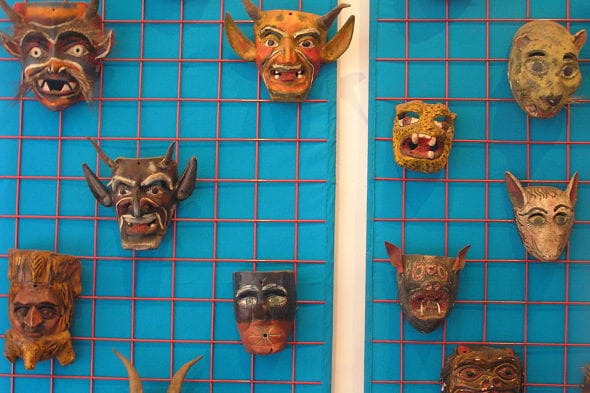
At night we arrived at the hotel. In the courtyard we expect an overwhelming spectacle. It is the "Dance of the Little Old Men". We see five men wearing peasant clothes and face covered with a wooden mask painted pink and toothless old factions and mocking. The dance begins with a slow choreography, resting on the heels and shake sticks on the wooden floor. The melody is catchy and melancholy. Little by little the pace quickens, the "oldies" which imps and released the song explodes like a fireworks end. Octavio Paz writes in "The Labyrinth of Solitude" representations Mexican folk are always a mockery of life, "Insignificance of human existence". The "Dance of the Little Old Men", their time funeral, we nail on the head. Reflects this deep feeling of loneliness-the speaker Peace- "That affirms and denies alternately melancholy and joy, in silence and the scream, Free in crime and religious fervor ", and defining Mexican identity.
Michoacán, as stated, is the land of fish. And if there is no water fish is because. And if water is because Michoacán boasts 25 rivers, 11 lakes and 214 kilometers of sea coast. We stayed with lakes. We visited Zirahuén and Patzcuaro. They say that when Vasco de Quiroga saw this last lake knew he had come to the right place to found his utopia. The mountain landscape, forest green and we look at it from the car window on the way orillamos is magnified when the Lake Zirahuén and entered a true orchard.
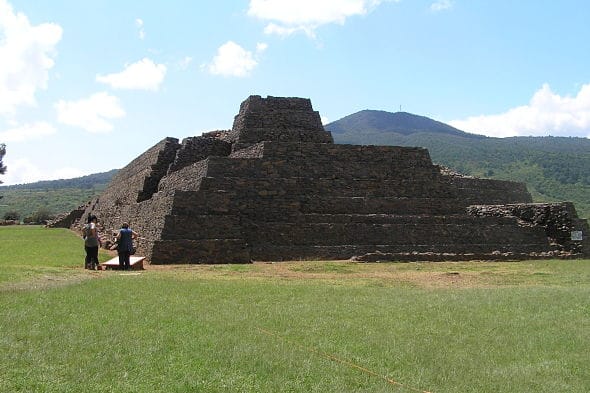
This nature also hides generous and abundant archaeological sites. The most spectacular is the Tzintzuntan, political center of the manor Purepecha
This nature also hides generous and abundant archaeological sites. The most spectacular is the Tzintzuntan, political center of the manor Purepecha, where stand pyramidal structures in which it is possible to find patterns in the rock engravings. In the village of the same name throught former Franciscan convent driven Tata Vasco. What was a layperson like him in such duties? Vasco de Quiroga, remember that he was a lawyer by profession and before reaching the New World served as diplomat-, was appointed bishop at the request of Charles V in 1537, to six years to reach Michoacán.
The next morning we headed for Paracho, the people of the guitars. We visited the artisan's workshop Zalaga Jesus Gonzalez. Five years ago he entered the Guiness book to make the world's smallest guitar. The gadget measures 3,2 inches and weighs 2,5 grams, little more than a nail. In a jiffy updates us. In Paracho there 18 guitarfish industries, 400 workshops and 2.200 people between workers and small producers. With big guitars waste, he made each year 40 miniature guitars for collectors. In Europe they pay 300 Part euros. "They are made with mahogany wood, Red Cedar, Hemlock ebony ", the teacher tells. "But the secret, materials beyond, is that we work with the soul, give life to something that does not have ".
Late afternoon and we headed for Morelia, the capital of Michoacan. We almost 200 miles and when we got, Surprise!. In the historical part of the city's colonial architecture remains unchanged, gorgeous. Don Vasco footprint is also visible in Morelia. But this is something I would have another day.


