
Routes in car….
Umbría is in the middle of two giants: Rome and Florence-La Toscana. And between two art and history giants there are always hurry to go from one place to the other. That does this invisible region for many travelers who pass through those lands by train, fast, Reading the collection of cathedrals and museums for visiting and trying to remember everything they already visited. Others go by car, And maybe they stop eating Orvieto, Some daring may deviate to Assisi, And they are still fast that darkens them in the coliseum or in Ponte Vecchio.
The years I lived in Rome, Umbría became refuge, In escape. I discovered it little by little. Brown in summer, Green in spring, reddish in autumn, Gray in winter. I loved going in the summer to contemplate his golden fields and his birds climbing through the trees. I loved going in winter to smell burned wood. I don't know if gods live there, But if the Christians exists I do not think that he walks very far from that Basilica of San Francisco de Asís With their frescos from Giotto that show that miracles are polychromatic.
Orvieto
A car route on Umbría could start with Orvieto. Halfway between Florence and Rome, The town is close to the highway. If you leave on weekends, Better go soon. It is filled with tourists and parking lots are scarce. Only Orvieto deserves a trip. I discovered it many years ago, just stopping in a journey between Rome and Florence. His cathedral was a shot in the temple. You walk down a narrow street, between restaurants and stores, And suddenly you see black stripes on marble with high pinnacles. And that leads to a square where you contemplate one of the most beautiful duomos in all of Italy. It is a triptych with gold mosaics. What else does what I describe, It is a majestic site, imposing, aesthetically beautiful.

The people also have the charm of so many Italian towns. A country from a thousand countries, where everyone raised their strengths and altars to worship virgins and artists. The well of San Patricio should not be lost either. Is at the entrance, near the main parking lots. It is a masterpiece of hydraulic engineering of the 16th century. He commissioned her in 1527 he Pope Clements Live, After the famous looting of Rome from the troops of Emperor Carlos V, To ensure the water supply of the fortress of Albornoz where the Pontiff thought that he could have a refuge in case of an attack on the eternal city. And what does the well make so special? That it is a double snail ladder of 53 meters deep that do not cross. It goes down one side and climbs on the other without understanding how. The halls are also illuminated by windows that turn the work into a suggestive hive, to clear. A decrease in purgatory.
Perugia y Gubbio
Ere orviet we go to perugia. The capital of the region is a good place to try or buy its famous truffle. If they are lovers of this expensive fungus, In all Umbría you will find a complete gastronomic offer that includes it. But also, The city has a historic center collected after its intact walls. PLAZA IV OF NOVEMBER, La Fortaleza de la Rocca Paolina, The Cathedral of San Lorenzo or the Fontana Maggiore are sufficient heritage to stop there.
Then, The road takes us north, to La Noble Gubbio. The town, of loaded historical artistic heritage, It is next to a characteristic hill in the Christmas period because they draw an immense colored light tree on its hillside.

It also has another famous onomastic. The 15 May celebrate the “Dei Ceri” party in honor of San Ubaldo, Your employer. The celebration already dates from almost 1000 years of history and has a pagan genesis. Ceres, Saturn's daughter, It was the goddess of agriculture. Today, After the Catholic hurricane, the Ceri, Some wood artifacts five meters high and almost 300 weight kilos, They are related to the saints of the three corporations of the city: SAN UBALDO PATRÓN DE LOS OBREROS, San Jorge Patron of the Merchants and San Antonio Abad Patron of the Farmers.
During the party, Each congregation loads its saint, that the wax behave, In a race that ends in the church of San Ubaldo. It is a show to which thousands of people go, So it is convenient to plan the visit.

In any case, Gubbio deserves a visit to its old streets, His palaces, walls, Churches and strengths, At any time of the year.
Spello y Spoleto
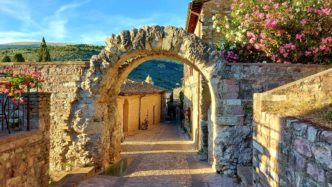
Returning to the south, There are two similar names that deserve a stop. The first is Spello, A small town on a hill. Amural, cobbled, With his tile roofs and his stone walls, I liked his tranquility. It does not have the big cathedrals from other Umbría locations, but a collection of small churches among which Santa María Maggiore stands out, place of worship dating from the 12th century. But what fascinated me from this place was his medieval air, Its walls and old doors, The mosaics on the ground, sandstone facades with geraniums, Slow life. I ever decided to sleep there, contemplating the plains, The olive trees and vines. That Italy drives me, For me the most interesting, almost nostalgic and romantic, With its past of centuries intact. By tradition, by attachment and, also, for reluctance.

Then, a 35 km, We found Spoleto. This is already major words. The town retains an overwhelming heritage. The German Goethe wrote on his trip to Italy of this place that “I have been in the aqueduct, which at the same time is a bridge between one mountain and another. The ten arches that dominate the entire valley, Built with bricks, They remain firm over the centuries while the water flows perennial ”. It was not the only myth in history in love with these lands. Miguel Ángel Buonarroti, Stendhal, William Turner ... felt the same.
The town retains its walls, And within them a dazzling heritage that goes from ancient Rome, With your theater still visible, to the medievo, Renaissance and Baroque. It walks, They have even made for people with mobility problems mechanical tapes from parking, And you eat, Babies, It is contemplated, You learn, It shuts up, looks, It is heard ...

Go, certainly, And if they like modern art, Reserve a lot of hotel hotel in advance to go to the International Art Festival, "Of the two worlds", that is celebrated there every year at the end of June and early July. The offer is varied and some of the best artists in the world come to show their music, danza, painting, Theater ... in an incomparable framework.
Assisi
Assisi is a miracle. Something magical should have happened because nothing is understood. I am not a believer and there I think. Again a medieval town, on a hill, amural, through which cobbled alleys slide, stately houses, Squares with old wells, balconies and arcades.
but the same, There might be all of all, be a dry hole, empty, And we should also go there to contemplate Giotto's frescoes in the Basilica of San Francisco de Asís.

Travel texts sometimes fall into the repetitive epithet. It is difficult not to fall into it, The trip is more adjective than noun, But there is no need. The Frescos of the Basilica of San Francisco, both the lower and the upper, They do not need anything that is not going, see them and enjoy them.
End of the trip. You can make this route on a weekend. Two or three nights. And then go to Rome or Florence, to take a flight, Upon returning home or continuing the trip. But stop in Umbría, worth.