


The trip


Claudio Fuentes (Conception)
The Huascar is much more than an old trophy of war to Chile or a simple and forgotten military loss for Peru. Since his capture in the year 1879 has not only been involved in major naval battles, generated even in this international political asperities between two neighboring nations.
During 2010 the then Chilean Minister of Defense Jaime Ravinet publicly announces his idea of ??returning to Peru The Huascar, which automatically generated considerable controversy and social policy in both countries. It is not difficult to find online articles related to hundreds of comments, mostly of high caliber.
Already established the validity of historical relic floating world's oldest, know the events that transform the Huascar in an interesting historical tourism.
The Huascar was built between August 1864 and January 1866 Laird Brothers shipyards in England, originally for Peru. The design of the ship was in charge of the official Royal Navy Cowper Phipps Coles. The new vessel is Huascar named after one of the brothers of Atahualpa, penultimate Inca Empire and son of Huayna Capac.
Under the command of Captain Grau, Huascar was transformed into a key part of the performance and participation of Peru in the Pacific War. The excellent strategic direction, firepower and strength of his helmet kept in check the Chilean navy for months.
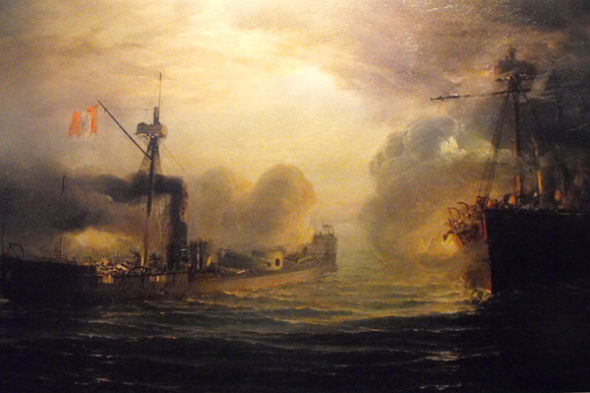
Everything changes the 8 October 1879 in addressing Angamos, where they are on combat ships and Peruvian Huascar against the Chilean vessels Union Cochrane, Blanco, Loa and Covadonga. Also present were, but without direct involvement, Transport ships Chilean Matias Cousino and corvette O'Higgins.
Chilean vessels take advantage of their superiority in battle and try to shut out the two Peruvian vessels, but the high speed allows him to escape Union. This is how the initial confrontation between Huascar and the Cochrane, the first shot being launched by the Peruvian ship without results. The Cochrane, for the time being, not respond and is fast approaching. The greater the distance, and in prosecution, Chilean vessels are Blanco and Covadonga.
Less than 300 m from the cross-fire becomes more intense with considerable damage to both vessels.
The Cochrane accurate volleys pierced the port side of the Huascar, killing a dozen men operating in the artillery tower, which hindered the maneuvers for several minutes. Also drilled the shield on the waterline, on the same side, averiando the helm of combat and leaving the Huascar manually browsing. One of these explosions kill Captain Grau, taking over the Captain Elias Aguirre Romero, who later dies too.
At this point, the Blanco and Covadonga de Chile had shortened the gap with the Huascar, opening fire on several occasions. Thus, the Peruvian vessel was finally enclosed in the Chilean vessels.
After an hour and a half of intense combat the Huascar was captured by the Navy of Chile. The Huascar had served his country during 14 years before being captured. Later, would add another 21 under Chilean flag to be dropped.
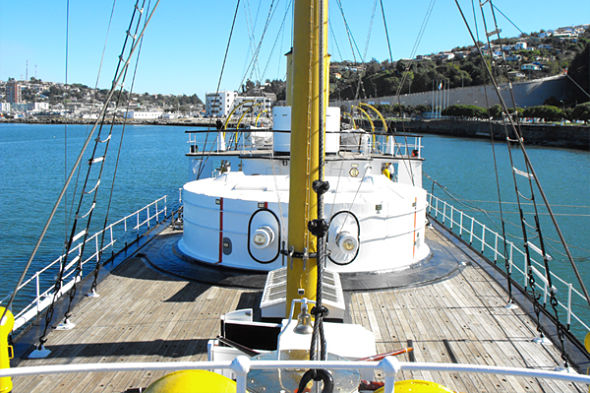
In 1951, thanks to the initiative and perseverance contraalmirante Pedro Espina Ritchie starts the full restoration of Huascar, which is currently anchored off the Second Naval Zone of Talcahuano in Chile, transformed into a beautiful floating museum.
The Huascar, today
The Huascar is a very special museum, is a unique experience. To
access it, two sailors of the Navy of Chile will carry on a barge.
When visiting this historic boat, a cluster of feelings invade you. Appreciate the powerful guns, the old wood under your feet and especially find the exact place where dozens of sailors gave their lives defending their ideals quickly changes your perspective of what until now has only read about in history books.
There are no major restrictions as you maintain the order and respect, allowing close enough to touch the different artifacts, walls, guns, helm, among others. The interior of the ship has its own magic, odor of the wood and iron, the movement of the sea that the boat creaks as you walk through its corridors and rooms, the altar where the sailors prayed before going into battle and machinery to transport you to view those violent years of wars and conquests.
More: www.turismoconcepcion.com
The road
Talcahuano, capital of the province of Bio Bio, is located just twenty minutes away from the Chilean city of Concepcion (509 km. south of Santiago, Chile). There are direct flights between the capital and Conception.
Direction: By. Jorge Montt, Talcahuano Naval Base. Phone: (56-41) 2745520 / 2746207
A nap
The Hotel Terramar (www.hotelterramar.cl) is a short distance away from major shopping centers, only banks and 15 minutes from the airport Carriel South.
A table set
A few meters from the military compound where it is anchored to the Huascar, There are four restaurants specializing in seafood (Emerald Restaurant, Villarroel in Almirante 110 local 1 and 2). The traveler can enjoy beautiful views of the harbor and out of the sea lions arriving by land a few meters from where we are. Do not forget to taste a Paila Marina, soup served in a clay dish with a delicious combination of seafood such as mussels, clams, picoro, conger, puree, and clams with a touch of white wine and egg. Frankly delicious.
Highly Recommended
-The visiting hours are, Tuesday to Sunday: mornings 9:30 a 12:00 hours and evenings 14:00 a 17:30 hours. The price for adults is 1.000 Chilean pesos. There are discounts for children and seniors.
-More photos about the Huascar in and about the city of Concepción and vicinity at http://www.turismoconcepcion.com/.


