


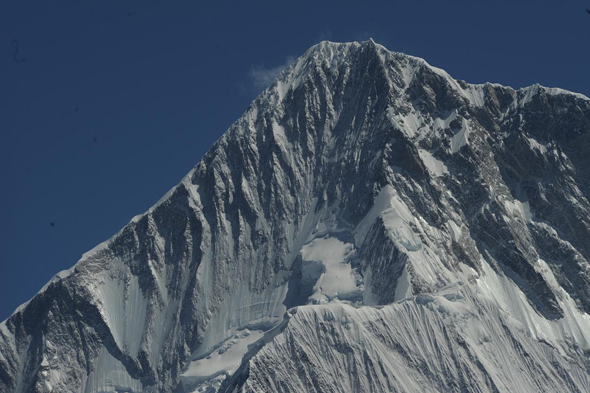
A look at mountaineering interwar must deternerse by force in the German expeditions to Nanga Parbat the 1930, 32, 34, 37, being last in 1939, when the war surprised the expedition in British India and were taken prisoner. On the incredible vicissitudes who lived to escape the concentration camp, Harrer (one of the winners of Eiger) wrote a famous work filmed: "Seven Years in Tibet".
I have already said enough in the atmosphere that developed these expeditions and summarizing the historian Helmuth Zebhauser: "In the thirties the military ideology of the climbers was confused with the military ideology of the soldiers". The innovative style he had used Alfred Mummery in this mountain would be abandoned and, perhaps because of the inherent risk of climbing in the high mountains of the Himalaya, expeditions would be imposed hierarchical, numerous and abundant material resources. Addition, External factors made these authentic German expeditions was resolved battles where the pride of a nation.
The price we had to pay was terrible. Nanga was buried in the best generation of German climbers
The imagination and daring of the greatest revolutionary discipline were replaced by, teamwork and the will to win at any cost. The price we had to pay was terrible. In only two of them, of the 34 and 37, disappeared 26 People. Nanga was buried in the best generation of German climbers.
Also noteworthy are the two American expeditions to K2, the 1938 (expedition was headed Houston) and 1939, in which Wiessner and Sherpa Install Dawa Lama (to meet with Tichy then in the first ascent of Cho Oyu), managed to achieve the 8.370 mts stopping just short of the summit. I also think it is important, altitude reached by the magnificent and climbers, the expedition Spike (7.755 mts) the 1931 por Shipton y Smyte (both participate later in the following expeditions to Everest). Also the first climb, a year later, of Minya Konka (7587 mts), by Americans Moore y Burdsall, a mountain great, unknown and very dangerous, unknown in the Hengduan Mountains of China. Nor do I forget, if only three lines, the unusual attempt Maurice Wilson, "The madman of Yorkshire", to climb Everest solo. An attempt, perhaps too "crazy", I would pay with his life.
Shipton was a strong supporter of small teams, strong and very attuned in the Himalayas. Here is one of the times that prelude
But, to end this war period, I would highlight the splendid activity Eric Shipton, one of the best climbers of the years-along with fellow H.W. Tillman– at a time when climbing in Asia was always linked to the exploration and adventure uncertain, with extraordinary expeditions to Nanda Devi in 1934, the Everest in 1933, 35, 36 and 38 (in none of which exceed achieved altitude 8.570 mts, namely, Scoring the same Norton y Somervell in 1924) and to the north and south sides Karakorum in 1937 and 1939, doing a great job mapping and exploratory.
Shipton, also participate in expeditions to Everest reconnaissance 1951 and Cho Oyu the 1952, was a strong supporter of small teams, strong and very attuned in the Himalayas. Here is one of the times that prelude, sin only porteadores, important loading bales themselves with their backs, very light material and greenfield. Perhaps because of this, or also for being an iconoclast with a fine sense of humor and hurtful- is so late would be replaced by Colonel John Hunt as head of the British expedition in 1953 achieved up to Everest.
Late Shipton would be replaced by Colonel John Hunt as head of the British expedition in 1953 achieved up to Everest
Eric Shipton end his days as a mountaineer exploring, already in the sixties, Mountains Patagonia Earth and Fire, achieving, among other, the first such beautiful mountains absolute, remote and fearsome as the Monte Bove and the French. Always true to his style as light, that allowed him to organize an expedition in the back of a postcard.
The Second World War was surprised while exploring the Snow Lake, a splendid ice field at the confluence of the Hispar glaciers and Biafo. Probably, Shipton felt something like that felt by many climbers to which, then, radically changed their life. They learned through a small radio. Then: "I felt for a moment as if the cracks had opened under my feet ... How foolish, how supremely ridiculous seemed all, in our remote and beautiful world of snow and ice!”.
«Nothing can alter the fact that, for a moment, we really lived "
Like many other climbers, of both sides, was a story that broke them life. Many would not Front. Others did life maimed or destroyed. The world would never be the same. Just what would they lived. Eric Shipton summarize knew that feeling in the last sentence of his book "summits" (3): "In these days of subversion and violent changes, when the basic values ??of today become tomorrow's vain, is best seen when the value of the doctrine which advises fully benefit from life while there is opportunity to do so ... nothing can alter the fact that, for a moment, we really lived ".


