





The rugged gorge through which our vehicle limps up leaves us speechless. The rock has been cut by a blade of water called the Kabul River and we are climbing that ancient scar with superb views.
This new door to the world takes us into a very conflictive area. We have left Jalalabad behind and are heading to Acceptance. After the town of Surobi steep mountains and claustrophobic gorges emerge where an arbitrary warlord imposes his law. Positioned like eagle nests, heavy machine guns from the regular army try to make travelers believe that the Government controls these mountains. A true chimera. Nobody is safe here. It was in this mousetrap with no escape that some alleged mountain bandits ambushed an escorted caravan of journalists., murdering three of them in cold blood. A plaque placed by the Government of Spain reveals that one of those killed was the Spaniard Julio Fuentes, El Mundo correspondent.
Heavy machine guns from the regular army try to make travelers believe that the Government controls these mountains
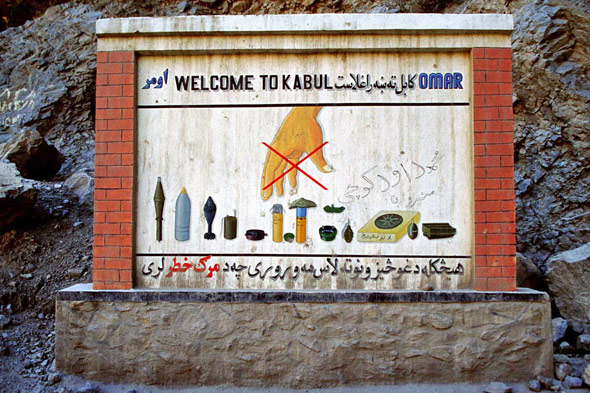
«Welcome to Kabul», reads a gigantic sign just beyond the stone alley that leads to the Afghan capital. Under that motto of hospitality, a great illustration reflects reality and the greatest latent danger. A hand crossed out on fourteen types of explosives and mines very graphically illustrates that death and amputations lurk in the form of diabolical devices.
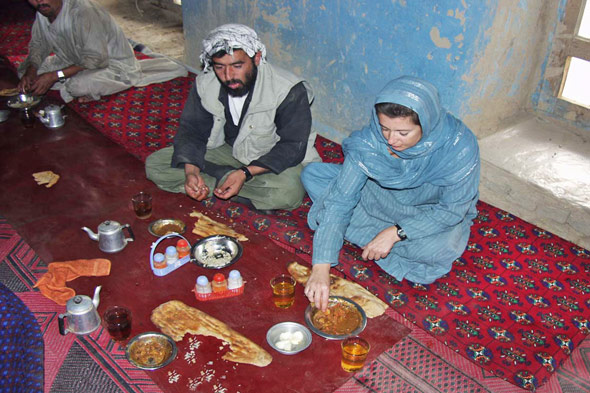
Mines are the nightmare of Nader, with whom we share rice, naan (pan), stew and carpet in the last "chaikana" ("tea house") before kabul. This young Afghan exiled in Pakistan has resettled with his family in Kabul and, with English learned by the need to survive in a foreign country, He confesses to us that he is not afraid of dying from stepping on a mine because Allah the almighty would welcome him into his bosom for having been a good Muslim.. What truly terrifies him is being mutilated in a country like his, where it is already difficult to survive being completely whole: "I would rather die than drag myself begging through the streets of Kabul". The morsel we have in our mouth chokes us.
Nader is terrified of being mutilated in a country like his, where it is already difficult to survive being completely whole
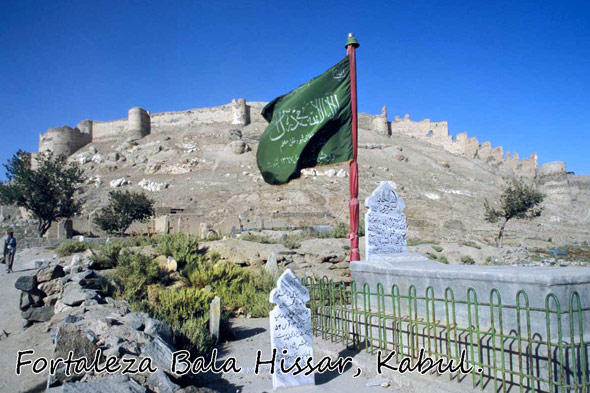
We enter Kabul. Mighty medieval fortifications dominate the ridges of the hills showing his warrior soul. As dust, constantly suspended for their blighted streets, music seeps through every nook and cranny. Sounds in pensions, stores, restaurants, taxis, hairdressers, through the small windows of the houses. The Taliban strictly banned it from their lives along with cinema and television (“Satan's box”, they are calling her). There is a popular Afghan saying that says: “Music was born in India, he spent his youth in Afghanistan, "She fell ill in Iran and died in Arabia.".
Walking through the streets of Kabul is like walking through the clogged arteries of a deteriorating, sick heart that has been forced to endure several heart attacks with its desperate attempts at resuscitation.. The trace of a quarter of a century of uninterrupted combat and repression is palpable in any of its historic buildings., a poisoned inheritance that falls on each new generation.
Walking through the streets of Kabul is like walking through the clogged arteries of a deteriorating, diseased heart.
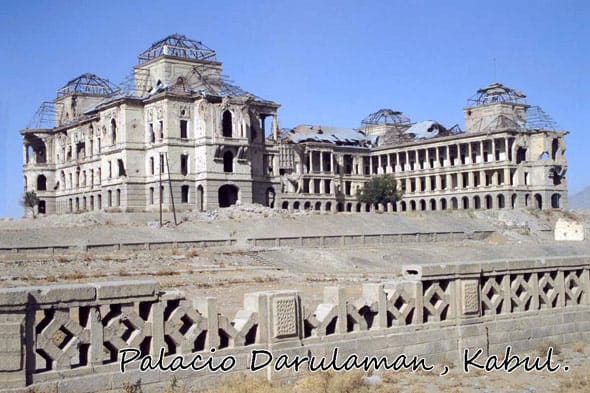
As we approach the Royal Palace of Darulaman It gives us the sensation of entering an elephant cemetery. Huge building structures, that housed ministries or former embassies look like colossal pachyderms letting themselves die. A desolate environment where not even the inhabitants of the capital dare to survive. The Kabul Museum, closed to the public, had to suffer the iconoclastic wrath of the Taliban, that reduced to dust more than 2.000 irreplaceable parts. We see that better luck has been in store for the Timur Mausoleum, near the Kabul river, where its architect tells us that the Aga Khan foundation is responsible for restoring the architectural relic…based solely on old photos.
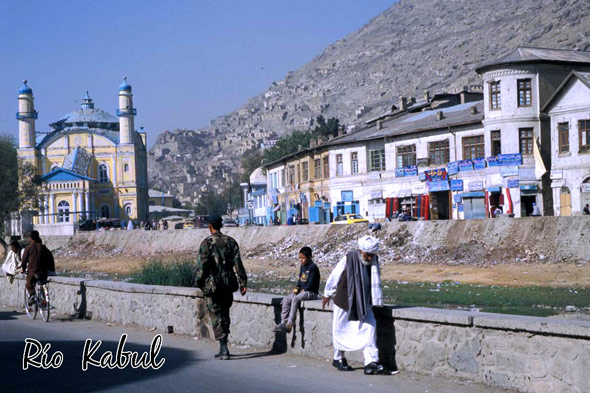
But it is in the markets where we best feel the pulse of the Afghan people. Everything is bought and sold except the smile, that they give it to us constantly. They invite us to tea, They ask us about our lives and tell us their personal stories, sometimes black, sometimes full of hope, but all with the hope of a lasting peace... that has not just arrived. Everyone in Kabul was elated with the end of the Taliban and, although at first they were grateful to the international coalition for having expelled them, now they want all foreign forces to leave. His maxim is "no foreigner will govern Afghanistan" and the rejection of the United States, as leader of the alliance, it increases with each passing day.
They invite us to tea, They ask us about our lives and tell us their stories, sometimes black, sometimes full of hope
But the reality is sadly bitter and hopeless. Among the Taliban, constantly harassing, the fundamentalists and the countless warlords, the country will explode into a thousand pieces again if the international coalition withdraws without first having left an Afghan central government accepted by the majority, mission impossible with a tribal idiosyncrasy like the Afghan. Suddenly, A distant sound brings us out of our contemplation and we quickly finish crossing the bridge over the kabul river to make way for the battle tanks of the international security forces that make an appearance. Without barely assimilating it, they quickly disappear from our sight, leaving behind a dusty halo.. People continue with their daily chores as if they had not seen them.
Women do not go unnoticed, precisely because of his uniformed and characteristic attire, the blue burqas, that move like waves through the dust. While we drink a warm cup of "cha" (green tea), Ghafoor, a college student, explains to us that it was not the Taliban who imposed the use of the burqa, because Afghan women already wore it traditionally. Its use was left to the choice of each family because in the monarchical era (1926-1973) It was not mandatory.
The blue burqas of Afghan women move like waves through the dust
The difference was that the Taliban turned women into furtive shadows and imposed a cloth prison on them within the rigid package of fundamentalist rules that the death penalty protected if it was not strictly followed.. “Now I have classmates again at the university, but the Taliban banned education for women, because they considered schools “the gate to hell”, Ghafoor qualifies us. But the sad reality is that, despite the expulsion of the ignominious Taliban Government, Many families continue to be threatened for sending their daughters to study and some girls' schools are burned down..
Kabul's sick heart has yet more heart attacks and more defibrillator shocks left to bring it back to life again and again. The time has come to leave the capital of Afghanistan to cross a gate in the Hindu Kush mountains and try to reach a valley that has made Buddha shed tears in his eternal rest.: Bamiyan.


