


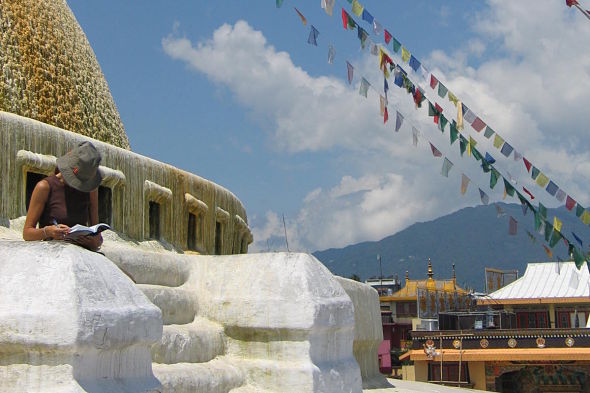
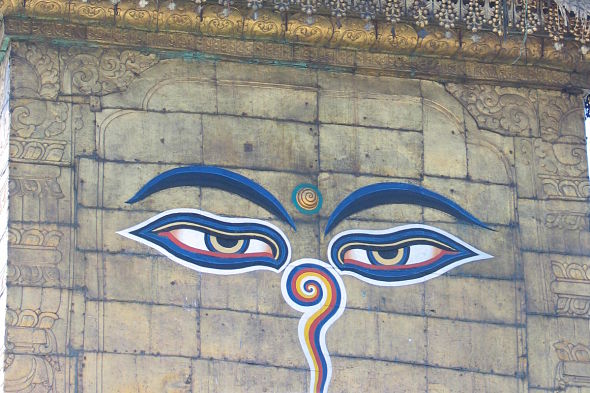
On a hill on the outskirts of Kathmandu stands the temple of Swayambhunath, known as the Monkey Temple by the large number of monkeys that roam the neighborhood. To reach the stupa have to climb 365 stone steps, each more vertically, closely stalked by a legion of macaques. Up, you seen the giant eyes of Buddha.




Text and photos: Ricardo Coarasa (Kathmandú)
The stupa is located just two miles west of the historic center of Kathmandu. We reached the place after you dive into the chaos of traffic on the Ring Road, the M-30 from here, during rush hour. The vision of the 365 steps is outright. We prefer to go by car. Swayambhunath ice, junto con Bodhnath, the major Buddhist pilgrimage site in Nepal, but while in the first Hindu influences are evident, the second can still breathe the Tibetan faith that captivated a century ago that great traveler who was Alexandra David-Neel.
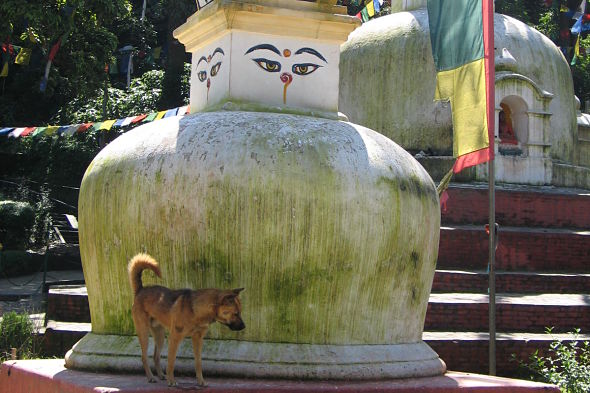
The Buddhist spiritual magnet is surrounded by small temples and shrines, each one more dirty. The pigeon droppings and the offerings of the faithful have wreaked havoc on the stone. Inquisitive eyes watching everything, over the thirteen steps that represent the levels of knowledge that leads to Nirvana, Buda eyes painted on each of the faces of the monument, immemorial a symbol of Nepal. Below them, a stroke that resembles a question mark and that serves as a nose is not simply the representation Nepali number one, symbol of divine unity.
As in the vicinity of the great temples of Catholic pilgrimage, The vendors also hope here to make a killing at the expense of the faithful. So almost always have one or two lads following your steps while waving the goods that you've seen over and over again. The heat is stifling and a bottle of water demand 30 soon come down to Rs 25.
The Tibetan rotating cylinders (in a gompa next to the stupa is one of more than five meters high) Hindu temples coexist with small. Buddhist and Hindu prayers on this hill are confused jumble of gods, Statues, shrines and temples coated with grains of rice, butter or smeared with red paste that evokes the blood of the sacrifices. In one of these pagodas raise families prayers for their sick children to the image of the goddess Ajima (Hariti for Hindus).
"It must be beautiful"
Place, punished by the sun and dirt, not invited to stay too. Must be something endemic, So David-Neel and pointed it extensively in his visit 1912. "It must have been beautiful before the dirt and neglect of indigenous people disfigured him", he wrote of this Buddhist temple, in which, remarked, "The dirt of the place is of a nature difficult to describe". For the intrepid traveler, "The atmosphere around the stupa would be almost disturbing if not dirt from causing disgust divert attention". One hundred years later, I guess Swayambhunath is still inadequate for refined spirits (David-Neel, intrepid adventurer if ever there, was not), but the dirt from, I must clarify, I at no time cause repulsion. In any case, views of the city for tourists to get abstract somewhat oppressive atmosphere that despite open meet.
We finally decided to lower the 365 steps of the temple, built in the seventeenth century by King Pratap Malla, a significant gap. Tibetans in exile wearily sweating up their fervor, pursued by the sun and clinging to the mid-rail to relieve strain. It almost seems to have raised awareness by car. The howler monkeys scrutinizing visitors looking for something to eat while traveling tireless offer local crafts. If you wear something you lost sight, because you will not be left alone. It is said that Buddha preached among these forests, how not surrounded by monkeys. In fact, the porch is littered with images of him and the two sons of Shiva (most revered Hindu deity in Nepal): Ganesh (which ends the human body with an elephant's head) Kumar y (the faithful who entrust their business prosperity). Down, stray dogs roam among smaller stupas reluctantly, as if to stay out of the territory of the macaque.
The statue of the heroine sherpa
Way of the stupa Bodnath, and Bouddha, Chuchepati, we passed the statue of Pasang Sherpa Lhamu, the first woman Everest Sherpa tread. He got the 22 April 1993, but did not live to tell, he died during the descent. Is, certainly, most revered women in Nepal. Full of posthumous awards and recognitions (was given its name to a road and even a seal with your face), in this place erected a statue of his likeness to size not to forget the feat.
Bodnath is the other side of the coin of Swayambhunath. Located six kilometers east of Kathmandu, This stupa 100 m in diameter (the country's largest) is the heart of the exile Tibetan, usual destination after China's invasion of the land of snow. The temple pales in importance compared to Swayambhunath, but it is definitely more authentic and, without discussion, much cleaner. What was already a century ago. "I was pleasantly surprised by the scrupulous cleanliness of the terraces and the entire environment of the monument", Then said David-Neel.
The stupa (that as the Swayambhunath suffered in the flesh coming from the Muslim invasion in the fourteenth century Bengal) is surrounded by shops in perfect magazine and the kora is traversed (always in the direction of clockwise) without strain. Even went up to the fourth level of the thirteen stages of knowledge on which perch the omnipresent eyes of Buddha. It is a haven of tranquility that pushes you to relax, the reflexionar, to let your imagination fly over the rooftops of the houses Tibetan.
After this bath of spirituality, unn little later we approached a Tibetan handmade carpet factory, where two women at the foot of a loom weaving carpets with the same care they have seen their mothers and mothers from their mothers. End, and after two false starts in Tibet, Tibetan carpet bought in Nepal after disbursing 400 U.S. dollars. Ironically travel.


