




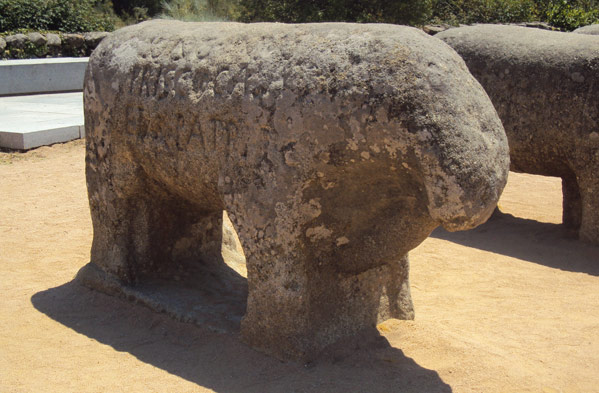

As i was seeing them, in the millenary weather between the ancient borders of the two Castiles, the image of the jihadist barbarians smashing the Assyrian sculptures in Mosul came to mind. The emblematic Bulls of Guisando, four were four, They are a capital part of the history of Spain. Right here, in a sale of which only one wall is preserved, Isabella began to forge his future reign, the one that next to Fernando of Aragon would impel him to the discovery of a New World that, from the green pastures of Guisando in the foothills of the Sierra de Gredos, and their 17 years, It should seem as far-fetched a possibility as the exploits that populated the chivalric books.
It was next to these granite sculptures from the Iron Age that his brother, King Enrique IV, swore Isabel as heir to the Kingdom of Castile to the detriment of her daughter Juana "la Beltraneja" (of doubtful paternity) giving foot, unintentionally, To the splendor of the future empire where the sun never set.
Right here, in a sale of which only one wall is preserved, Isabel la Católica began to forge her future reign
He had noticed the sign a few days before while driving on the N-403, after leaving behind the Madrid town of San Martin de Valdeiglesias, towards the Burguillo reservoir in Avila. The detour to the Toros de Guisando by AV-502 was suggestive enough to return as soon as possible. And I did it the next chance that came my way.
I was expecting a modern interpretive center at the height of the history of the place and I was afraid, even, that my trip would be in vain if visiting hours played a trick on me (I admit: he hadn't scoured the internet for information, because sometimes going blindly to the sites is the only way to keep the ability to surprise intact).
The detour to the Toros de Guisando by AV-502 was suggestive enough to return as soon as possible
Nothing like that happened. Just a few kilometers from the detour, another small sign indicated that I had reached my destination and, a few meters ahead, I stopped the car on an esplanade on the left shoulder, next to a stone fence that in a small section re-emerged as a wall. The legend about the stone, that is not even appreciated from the opposite lane, is unequivocal: «In this place Doña Isabel la Católica was sworn in as Princess and legitimate Heiress of the Kingdoms of Castile and León on 19 September 1468». A little further down, a more modest inscription keeps the memory of the benefactress of this corner of the history of Spain: «He had this inscription placed in the year 1921 Doña María de la Puente y Soto, Marchioness of Castañiza.
At the end of the wall an open door, a brief information panel… and the bulls. There were no schedules or anyone in charge of charging visits. It is a monument open to the 24 hours of the day 365 days of the year. There was no one else. A group of bikers had just left. As petrified as the sculptures of the Morlacos, Then the angry hammer blows of the bearded men in the Iraqi museum shook in my head. Anyone, thought, could come here at night and treachery to settle accounts with the memory of the Catholic queen who expelled the Moors from that same Al Andalus that now, five centuries later, Islamists vindicate with fury.
As petrified as the sculptures of the Morlacos, The angry hammer blows of the bearded men in Mosul shook in my head
Perhaps in Spain we have an overabundance of stones (in fact, Similar sculptures are counted by dozens in the fields of Castile). Maybe, also, we are increasingly reluctant to polish up a part of our history that we have been taught to tiptoe through. Maybe both at the same time. But it seemed to me that the Guisando Bulls, the enigmatic gift that the cattle people of the vettones left to posterity ago 23 ages, they deserved better luck. To at least keep them safe from occasional acts of vandalism.
The painter Gregorio Prieto already alerted in ABC the 30 October 1955 that "it would be possible for someone to steal one of them and take it abroad as a priceless artistic-historical treasure". But, To me, more than Erik "the Belgian" on duty, what came to mind were the statues of Mosul and the collapsed giant Buddhas of Bamiyan.
The enigmatic gift that the vettones left for posterity would deserve better luck, to keep them at least safe from occasional acts of vandalism
One step away from the royal canyon, these emblematic bulls look more like boars (only when observed closely do you see the holes in the stone in their heads where, presumably, the horns were found). What do they do here? What was its function? The most plausible version is that they fulfilled a protective function of livestock and pastures, because the place is the epicenter of electrical storms, a telluric force that did not go unnoticed by the vettones.
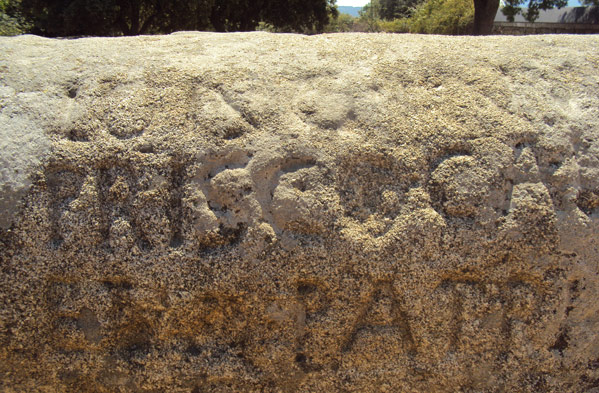
The only clue that these stone morlacos that look to the West give us is an inscription in Latin on the back of one of them: "Longinus did it to his father Priscus of the Calaetians". And one, under the scorching midday sun that casts no shadows, runs his fingers over the letters carved centuries ago with the same devotion with which he would slide them through an old map of unknown names. Because the story, often, is written on pages of stone.


