


The trip
Cadiz is one of those cities that you never want to go. Its prime location has been, throughout history, object of sieges and sackings. The danger came from the sea almost always. A tour of defensive fortifications and defenses is a journey through time with a superb cicerones: the Atlantic and taverns of old Cadiz.
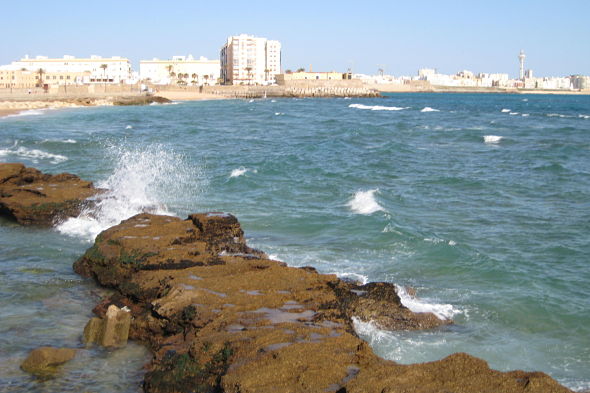


For the people that learn from their mistakes the future is an ally, never an enemy. Cadiz dismissed the sixteenth century with a great siege, the British army commanded by almirante Howard, eager to seize the Spanish galleons ready to sail to the Indies. The city was sacked and burned in July 1596 (as nine years earlier by the pirate Drake) and the authorities understood that they had to strengthen their defenses to avoid another disaster. During the next three centuries were put to work and, still, these fortifications are a symbol of Tacita de Plata.
We looked to the past of the city in the South Field Avenue, where the easterly wind stirs the smell of sea and fishermen rods are in the sky one morning begging favors. Politicians decided one day to change the name of this road that had baptized street wisdom, with full justice, as Paseo del Gale. They will know. A step away from the popular beach of Caleta, look at the sea of ??equally famous Vine neighborhood, is the Bastion of Martyrs, raised in 1676 to reinforce the defensive walls. Refurbished just twenty years ago, has changed its old artillery cookers, it now houses a popular restaurant.
At one end of a small isthmus linked to the city by a narrow boardwalk over a mile poke the walls of Castillo de San Sebastián, raised just after the sacking English. In this strategic place, actually two tiny islets, rose in the past a temple Phoenician and Muslim watchtower. It gets there through the unmistakable Caleta Gate, formerly flanked by two watchtowers near you, to mid-fifteenth century, a group of Venetians built the chapel of San Sebastian, which gives its name to the castle.
A mid-fifteenth century, a group of Venetians built the chapel of San Sebastian, which gives its name to the castle
Walking through this pretty boardwalk, Street now Fernando Quiñones, is a delight. Until the nineteenth century, when the tide came in the castle of San Sebastian was isolated from the rest of the city until the tide. Front traveler, the other side of the creek, rises Castillo de Santa Catalina, the other guard centenary of the Caleta beach. The couples are cooing in the sand, groups of kids dive into impossible antics from the boardwalk and the wind shakes a handful of comets in absentia. Behind us shines the golden dome of the cathedral, monitored for its pristine oyster stone towers (prepared with marine shell remains).
Just a step from Puerta de la Caleta, in the number 15 of Calle San Felix, is one of the gastronomic temples of old Cadiz, El Faro, where the traveler is layered on the bar (sitting down to eat is only available to the pockets more comfortably) and pleasant-looking cane truce, gazpacho and shrimp batter flag- a history of tantalum.
Comforted stomach, continue along Avenida del Duque de Najera, the urban ring that encircles the Caleta beach, towards the castle of Santa Catalina, displaying his stone bluff above the fishing boats swaying with secular laziness on the sea shore licking. Built in 1598, two years after the ill-fated British attack (although work continued for over twenty years), this fort is the oldest town and takes its name from the chapel dedicated to the saint in the same place in the early sixteenth. Even before the castle was built defensive stronghold during the reign of Felipe II, who attended the tips Antonio Zapata, the very young Bishop of Cádiz (reached only the ecclesiastical dignity 37 years), and strengthened the defenses of the city. Over the years, Carlos III used it as a military prison.
To reach one of the bastions, that of the Candelaria (1672), must continue walking down the Genoese Park. As natural guardian of the port, This promontory has been throughout the centuries the main victim of the city's maritime attacks, to the point that has required numerous reconstructions. Until recently housed the Museum of the Sea and was home long before the pigeons Corps of Engineers, but today is a leisure and entertainment center.
From the Alameda de Apodaca, with the stronghold of La Candelaria aside and Wall of San Carlos other, looking at the Atlantic leaning on the parapet is to go back to a time when Cádiz was the usual starting point for expeditions to the New World. The murmur of the sea dwarfs everyday concerns and gaze lost in the horizon of water, where shipwrecked mariners dreams.
The other bulwark which defended the entrance to the bay, that of Santiago, located behind the train station in the Cost of lime, parapet serves as a parking. Worse fate befell the San Roque wall, that through the Land Gate leading into the old Cadiz. It was partially destroyed in the years 40 the last century to improve city road communications.
Very close to the Paseo de la Apodaca, the traveler dismisses the journey through the history of the forts of Cadiz Cumbres (Zorrilla, 4), that is to offer customers the most succulent meat saw Iberian Huelva. I preferred, however, accompany the beers with some garlic prawns. I seemed more appropriate as modest Homenaje al brave ocean.
The road
Major airlines have frequent flights to the nearest airport, that of The Vine Jerez de la Frontera, located 35 de Cádiz km.
By Road, The city is connected to the A-4 (Motorway of Andalusia) y la N-340. From Seville can be reached in just an hour (125 km) if congestion in the metropolitan area of ??the city of Seville not cross your path.
A nap
The hotel supply is ample. VaP. has no recommendation to do about it.
A table set
In the Uncle Square Chalk (neighborhood of La Viña), the restaurant of the same name is worth a stop on the sunny terrace protected by a mosaic of the Virgin of Sorrows. The shrimp omelet, a must. This corner of Old Cadiz is nicknamed the composer Antonio Rodríguez Martínez, a reference in the nineteenth century Cadiz carnival, served in these streets its nerve center.
Highly Recommended
Strolling through the neighborhood of La Viña is essential to soak up the idiosyncrasy Cadiz. The old Cadiz where people still greet each other when crossing the street, that of the taverns where customers seem family and the elderly in the bars still make hand account. Indulge without direction or maps. A luxury, and say.
[tabEND]


