


-Peering? Across is always a need?
-It is the effect of the hill, rather than from the top. When you get to the top is opened a world to you. You have only just begun. But the summit is an end (on a border). From the summit we must return. The pass must pass through. There are peaks that look like Uttermost, particularly, el Everest, prominence last you almost out of the Earth. But what if it had behind it a panorama of peaks endless since there are discovered only? Then retornas, prosigues you recover and search in a new line of the horizon. If you look out the other side you're conforming to one side of the world. Also, when you poke, you can master the frenzy of the endless.
-What lurks behind the scenes of Everest?
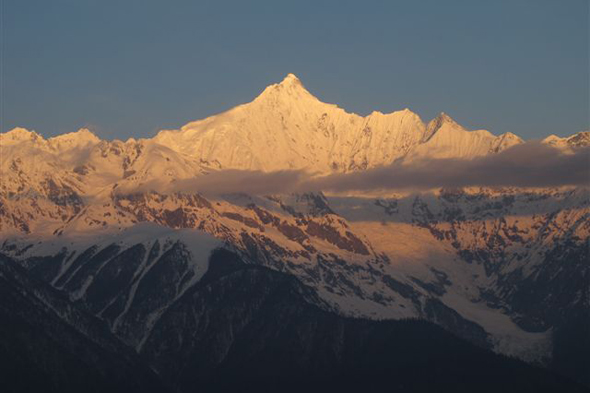
-North of Everest, from the great mountain range of the Himalayas, displays a beam traversing ridges much of Asia, with high altitudes, extraordinary lengths, superior beauty, great loneliness. Not appear in the press, not in the books, no detail on maps, not sound in newsletters mountaineers, There are commercial companies including base camps or crowded. Scenarios are sections, even wild. Anyone wishing to know the solemn nature hidden, still remains in a world increasingly adulterated, and learn their strong cultural content, must lift the veil and enter the space that opens after the known.
There are peaks that look like Uttermost, particularly, el Everest, prominence last you almost out of the Earth
-You speak of hidden mountains, unknown valleys, remote villages… Is there redemption for those who can not get that far and, however, feel the physical expression of intellectual passion which he referred Cherry-Garrard?
-There are many great world closer to home, in plains, hills, coasts and mountains, although you have to dig a little more to reveal their values ??perhaps covered by custom and spent by the excessive use, and we must persevere in care for, to protect them from deletion. Because there are landscapes faded as when passing by the blackboard eraser, both here and in China.
But an observer is respectful Land values ??in neighboring Sierra, eg, therein Madrid, beside, in Guadarrama, or in Huesca in the Sierra de Guara, let alone in the Pyrenees. Therefore it is very important to preserve these places, with an ecological, clear, but even more, with a cultural sense and to a profound experience of nature undisturbed. They are the last refuge of a world that was so extensively only a century ago in our own territory. The first Spanish mountaineers had other mountains in the same places that the current, more lonely and remote, wilder and withdrawals, most unexplored, most picturesque and vernacular.
There are many great world closer to home, in plains, hills, coasts and mountains, although you have to dig a little more to reveal their values
-He just presented his book in China, and looks set to translate into Chinese. Do not deny that you're going countercurrent.
-I've never detected well what the current, so I'm not very aware of go for or against it. But I do know that I am a teacher and I should pass on my knowledge, that's my vocation. So I think there will be a Chinese reading public can understand, amar, enjoy and preserve their mountains forgotten. Only love what is known and so you have to make it known. But, course, to care, not to damage. Also the man is educated positively direct contact with nature and those places can provide interesting insights not only for science but also profound experiences in those who roam.
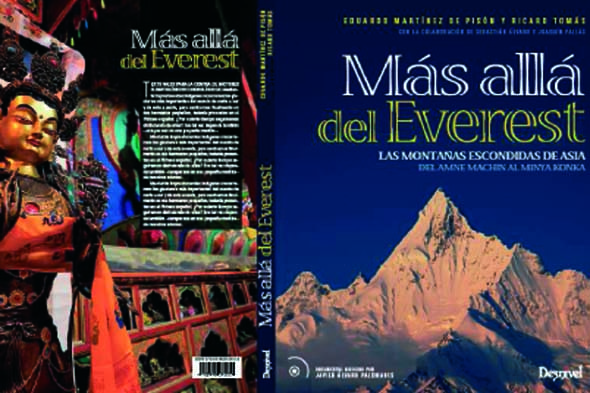
As there is very little written about these places, at least to all, the two authors of the book, Ricard y yo, and his coauthors, Sebas and Joaquin, thought their dissemination, here and among the inhabitants of China, may mitigate this information gap.
-I guess you can explore the mountains with his friend Sebastian Alvaro, legendary creator of "The Edge of the Impossible", is an added pleasure.
-Of course. We have spent many years running around wild and remote sites, even have been together at the North Pole. But, in this case, China we traveling together since 1997, although both had been there before, every man for himself. From 2007 We have gone every year to western and central China on tours with Ricard and other friends, Joachim including, by lost places, as the Taklamakan Desert, and Gobi, or the great ranges. Of these trips was born the idea of ??making the last book we have brought together. First we made a recognition of the regional environment of these mountains. The following year the cross completely from end to end. And the next we enter them, ascended its sides, the study, take data and we were able to write about them.
Sebastian Alvaro is a great expeditionary, with whom you can go to the end of the world and you get to him, and also a great person, with whom the journey is a joy
Addition, Sebas and I have written several books together. Ie, we already have experience of how to work joining forces. But, especially, Sebas is both more: on the one hand, a large expedition, with whom you can go to the end of the world and you get to him. And, other, a great person, with whom the journey is a joy and a test of friendship at all times.
-What remains of Himalayan Mallory, Buhl, Bonatti o Herzog?
-Times change, their obligation is to change. It is very good to know, but the story flows like a river and the water of today is not the same as that of the source. It may have even spent time nostalgia, is legitimate, but today and tomorrow are and will be different. What should not change in amending, however, as a living person who is the same and move at a time, is the substance. The substance is that which necessarily remains silent, is identity. They created the substance and what time were allowed and facilitated; pioneered mandatory, could not be anything. And that is much rarer today, less possible. But they created ethical and sporty style, both.
-Then, Does that legendary spirit still survives?
-What has changed is sometimes formally, accessory: best teams, faster communications, mobile coverage, geographical positions, sports techniques, mapping, information, etc.. That does not remove the substance, but amends the objectives and tactics; today there is a nonstarter brave mountaineering in pioneer days, but has the same spirit, Thanks to these improvements formal.
What is not so clear is that in certain practices and certain mountains to survive the styles of the great mountaineers who created and founded the Himalayism. Expeditionary marketing or competition or the claim to fame from the show can lead to a distortion or perversion of those foundational ethical and aesthetic principles. It is the spirit that has changed.
But it can also happen that certain mountains, that were solitary and demanded some epic, today its excessive traffic, commodification equipment or have them carried in them is now impossible to find the conditions characteristic for the substance of the great Himalayism can recur. Although requiring efforts and even lead to dramas, as the Himalayas always very demanding, the place is no longer necessarily the scenario demanded that spirit. In this case, is the mountain that has changed.
The ochomiles attract that promotes public and marketing, that can be indifferent to the environment
-Do you think the collecting eight thousand mountain is respectful?
-It depends on how it's done. It is again a matter of style. There are highly skilled mountaineers who make and repeated even measure ochomiles because it is their mountain. As others do tresmiles, eg. The often repeated a peak by different routes. Others insist that level by sporting set goals and do so with good manners, being very estimable achievements. But, if there are those who seek competition, exclusive fame and funding, because good style fails. But in these cases the lack of respect is not the mountain, but the substance mountaineer of which we spoke. If large expeditions are undertaken that do not involve environmental protection and waste materials and leave, then it is the same mountain who suffers from this invasion. The ochomiles attract that promotes public and marketing, that can be indifferent to the environment. In this case there lack of respect for nature.
-Climbing a mountain is a metaphor for life. What do you look at them?
-It is a spiritual metaphor, with many content. Ascension, ascetic search above, detachment from earthly become religious symbols, even mystical. What are different beliefs. And something about this in every climb, even for a climber reasons lay invisible. It is a matter of cultural roots. But besides the mountain usually returns a constant, an essential reference in the life of mountaineer, so that gives large amounts of capital available time, Stress, of money illusion and even. It identifies the ideals of his life. And, when going expeditions, that require lengthy stays in the mountains, it becomes life and life in mountain: eg, for true mountaineer, three months in Patagonia, two in the Andes of Peru, four on the Himalaya, mountain in a year, the rest scattered over the Pyrenees or Gredos… and so year after year is not that live in the mountains or near? In the high mountain may not be born, but you live and to die; has the characters almost full of life itself. He enjoys and suffers.
What is sought is a simple life experience grandiose nature, experience the beauty and the challenge, live with spontaneity, learn the rules of the Planet, through their trials, know intimately, be one with the stone, Storm, the torrent, ice, the plant or of animal Libre. Be free and happy among the things of a world admired.
Always reward the top is a moral.
The mountain usually returns a constant, an essential reference in the life of mountaineer. It identifies the ideals of his life
-Does curiosity has retirement age?
-I can not judge for others. There are those who have never had any curiosity. But you should not have retirement age. Personal life is not identical with belonging to class active and passive, even in this sense. That's a social rule, administrative, no vital. Curiosity indicates vitality, eager to learn, met, communicate. Curiosity means having future regardless of age.
-Do you think that in Spain we have been taught to love and respect the landscape?
-I think not. Minority, Instead, in our culture has been recent large landscaped, who have described the scenery, they have been loved and have instilled their respect. Even they have been educated in these principles. But the general trend is indifferent to landscape. Most do not even see. Perpetrators governments affecting the local, only see territories, economic exploitation, profitable farms, almost never see the Landscapes, if they fall into the temptation to see them, repent immediately. The evidence is right there: look out the window of the car and the train and tell what you see.
It would be very urgent safeguarding our landscape heritage, very, very urgent. It is a natural and essential cultural. Without it, if borrásemos, identity would not.
In Spain the general trend is indifferent to landscape. Most do not even see
-Trying to understand the peoples across the landscape or vice versa?
-It is a mixture necessary, because man remakes the original landscape and the landscape is an incidental ingredient of your life. You make the landscape and scenery makes you. Peoples are not separable from those of landscapes and culture and peoples utilities. So in a landscape reads a people, either way this landscape, the beautiful sea feo, kept the shattered, telling us how these people culturally, style, quality, its barbarity. And, in combination, in a town you can read what your landscape, in their actions, manners, lifestyles, music, film, literature. Understanding, as, is full or not correspond to reality.
-One reason for not bowing to the routine
-Life goes calling options, resources, responses in time. Circumstances change, request. Better, to my understanding, face life off the beaten track, outside the train routes and timetables stations marked on the guides. Through field. Then the world is less flat, find surprises, there may be more unexpected, but even these may be more interesting than all expectations.


