




Tashilunpo monastery was home to the second authority in Tibet, The Panchen Lama. When the Dalai Lama fled the Chinese invasion, Beijing sought and found their support. But the idyll did not last long and ended up imprisoned Panchen Lama. I'm in Shigatse, at the foot of the largest Buddha statue in the world. A monk asked me 30 photograph yuan. Is it true that some of them are Chinese agents?
Fourteen years. During that time, there was no sign of the Panchen Lama had been complacent about China's invasion. That photo with the guarantee that Mao was the communist regime needed to silence the atrocities being suffered by the Tibetan people (was not the only, a very young Dalai Lama was also dazzled by the helmsman at first). But the Panchen Lama went frog. Ended up giving a fist on the table and Mao himself denounced the Chinese in Tibet riots. I was about to fall from grace.
The occasion was painted during the celebrations bald Annual Great Prayer Festival and Lhasa and 1964. As the first Tibetan spiritual authority in the absence of the Dalai Lama, the crowd waited expectantly for his words. China also. It was his last chance to mark the distance with the Dalai Lama to Beijing Relief, always interested in addressing both authorities to fish in troubled waters. Opposite happened. The Panchen Lama claimed the independence of Tibet and hoped that the Dalai Lama to sit "again on the throne". It was much more than the Communist bosses were willing to tolerate. He was imprisoned and tortured and, of ally, became "a big rock on the road to socialism".
It is really overwhelming presence of the Buddha bathed in 300 kilos of gold and precious stones
The Panchen Lama was swallowed by the earth for fourteen long years. Desperate, attempted suicide several times in prison. Reappeared in 1978, but years of imprisonment and the threat of returning to jail muted his public criticism. He worked in the shadow of the settlement between the Chinese and Tibetans returned to Tibet in spring 1982 to die surrounded by mountains. Seven years later, died of a heart attack in his beloved monastery to Tashilunpo 53 years. Many still believe he was poisoned by the Chinese Government.
The Buddhist "tail collector".
Founded in 1447, Tashilumpo is reason enough for the maps included in Shigatse. Upon entering the main street, the golden roofs of the tombs of Panchen Lamas immediately called the attention of visitors. To the left is the Chapel of Jampa (Maitreya), Buddha of Kindness, immortalized with an imposing statue of 26 meters high. Built in 1914 under the auspices of the ninth Panchen Lama, nearly a thousand craftsmen and construction workers participated in for four long years. It is really overwhelming presence of the Buddha bathed in 300 kilos of gold and precious stones.
In a corner, a monk sitting cross-legged on a straw mattress keeps a watchful eye. For every photo you have to pay 30 yuan and this "debt collection" does not lower the guard Buddhist. Faced with such magnificence, surprised to see the rats walking your craving for sacred images. In the ancient hall meetings, where the monks gather to pray after meals, two huge rodents climb, the indifference of the religious, the image of Sakyamuni, "The Sakya sage", the original Buddha, known by Tibetans as Sakya Thukpa. Beware: dozens of stories circulating about monks related to Beijing ready to denounce the pilgrim or tourist caught with a photo of the Dalai Lama or denouncing Chinese policy in Tibet.
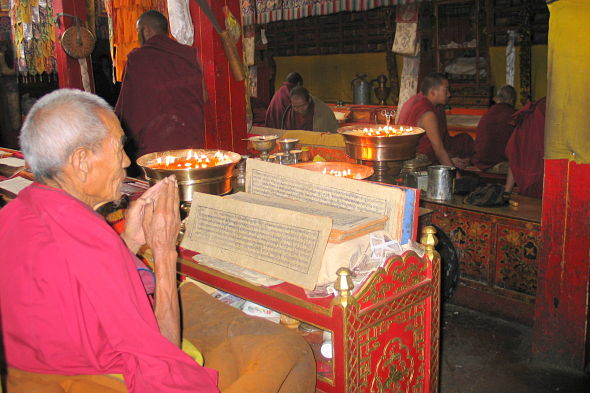
The Assembly Hall is a good place to sit and watch the monks and listen to their spiritual litanies. Atril situated on a small parchment with the prayers. Stay lit only by a few yak butter lamps, the atmosphere surrounding the visitor has an aura of unreality, pinch of pleasure from another era. That envelope is not eternal mysticism and grotesque dissipates when the monk who leads prayer is set to count the wads of yuan left by tourists. Is the toll of globalization.
Travel to the Middle Ages in jeans
Facing the giant Buddha giant rats, the tombs of Panchen Lamas detract somewhat, although stunning mandalas (circular representations of the spiritual world of Buddhism) decorating the roofs themselves justify a visit. But the best, insist, is through the different chapels with eyes wide open and the ability to surprise intact. It is a trip to the Middle Ages with jeans and digital camera. Opposite the tomb of the Fourth Panchen Lama, the only one that survived unscathed to the pernicious delusions of the Cultural Revolution, an old monk hits us in the back with a rusty knife desoyar yaks to cure back pain, but the old hands gnarled with such verve makes that point is of a vertebra out of joint. Natural medicine has these things.
It is difficult to entrepreneurship in a place where the waiters cut into four pieces and napkins to save paper
In either rooftop views of the valley are spectacular. Even more since the kora (spiritual circuit around the sacred sites of Tibetan Buddhism) surrounding the monastery, dotted with human excrement and the occasional dead rat, dry as esparto. We give a small alms to a beggar old and a nun who keeps a huge prayer wheels to be surrounded three times and, after forty minutes of walking, descend to the Tibetan quarter, leaving aside the road leading to the fortress destroyed by the Chinese. The dogs bark while we're giving away lanes of mud puddles, stones such as breads and women spinning in dark hovels. Back at the hotel Tenzin, try a coffee at the restaurant on the terrace with beautiful views of the Dzong. The waiter had to take the day off and we are forced to withdraw. It is clear that business acumen is one of the virtues that adorn the Tibetans. It is difficult to entrepreneurship in a place where the waiters cut into four pieces and napkins to save paper.
As in places like this in the evenings can be eternal, we went out to buy some souvenirs at the Tibetan bazaar. Professionals child beggars haunt us for much of our tour. No more tourists who move. One, Waving without fail two repulsive yak hooves, like something out of "Viridiana", great Buñuel film where a gang of needy are given a gargantuan feast. In a city with almost no cars, the few who wish to be circulated notice and do not stop blowing their horns. It is the eternal liturgy that, here and there, make your life a showcase.
As on our way to Everest base camp in Rongbuk we are the hardest days, advantage to give us a hot shower, probably, miss in the coming days. It is not only toilet paper and a dirty towel that had to bring in another room after asking to be moved the one we had. The beds are doing and it seems that today they intend to clean the room. Minor problems, in any case, not detract from the immense joy of entering into the most wonderful mountain range on earth.


