


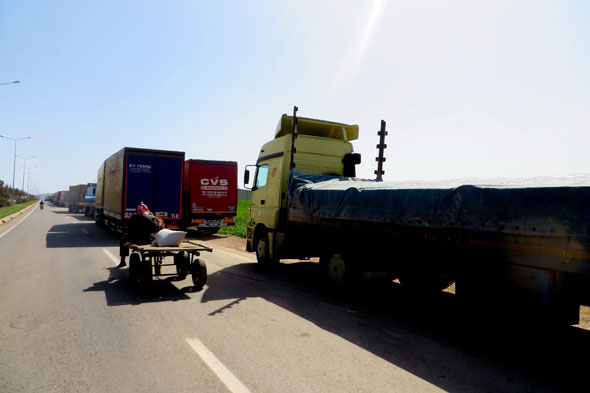

From the entrance of the city of Reyhanli, A few kilometers from the Syrian border, A row of trucks waiting standing in the arbitration begins. The parked vehicle tail is endless. Drivers sleep under some shadow, They make meals with hornillos or chat in groups with chairs that have planted on the asphalt.
Five kilometers later, The two senses road has the same scene but duplicates the trucks. Frigorific vehicles are diverted to the left of the left, In the opposite direction, while the rest, already in double row, Keep waiting for a tail that never progresses. A road that about four kilometers from the border enters the right offers the same picture. There are thousands of trucks waiting for a step to neighbor Syria. Many of them carry old Asian cars without registration. The calculations we made with the accounting of our car is that the tail was almost 20 km.
A guard shouts with some drivers
On the border the confusion is huge. A guard shouts with some drivers. They occasionally give way to a single truck and around there are a lot of hustlers who approach our window to steal time and ask for money in exchange for getting off the hell, We deduce from the mimicry of his can. His faces and gestures are aggressive, Your scars are looks. Some are children or adolescents, humble, that run between vehicles kicking their wheels. No one speaks English and does not allow us to approach beyond one point about a hundred meters from the edge.
We decided to return to the city of Reyhanli, in search of one of the fields of Syrian refugees that are in their vicinity. The city does not seem altered in its normality. Young people leave school and get on their motorcycles or connect in internet coffees with their mobiles. The city is wrapped in the same electoral posters that hang around all the cities of the country before the next local elections. One waits that time stops lamenting against misfortunes, But life always passes over death. Everything flows, continues, and only the dead get off that inertia of movement and, hopefully, We grant them a small high of 30 minutes that will be your burial. Nothing, Soon everything starts to live, a andar.
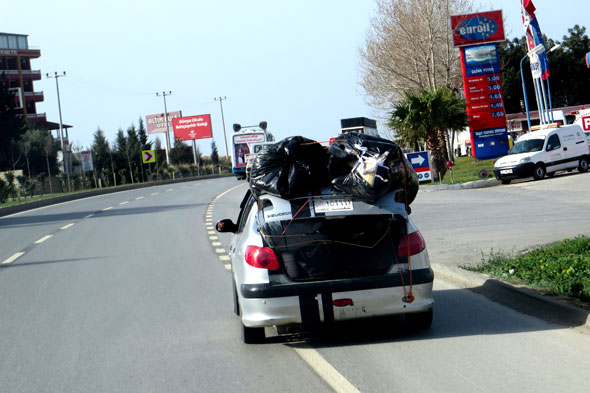
Do you know where we can find refugee fields?, We ask a guy who speaks two words in English. It indicates a road in the direction of the city of Hatay. On the way we cross with numerous cars with Syrian registration that carry a house in the trunk. The capota is always open and bags and suitcases are tied with strings. That scene has been repeated in the last hours on numerous occasions.
It is a prison of free people who must choose between living or dying indignantly
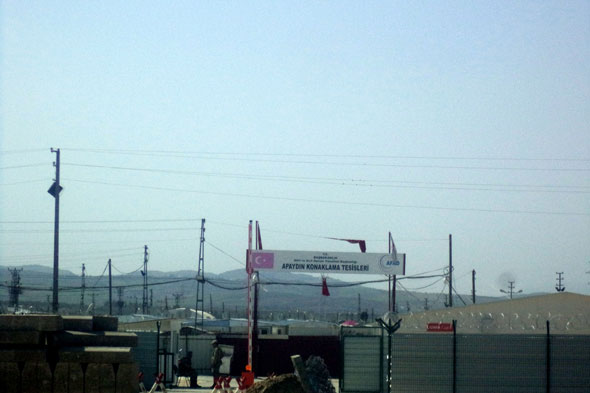
Finally, halfway between both cities, We arrive at the Dermikopru field. The entrance is strongly protected by armed soldiers and safety barriers. The entire perimeter is fenced with a skewer wire. Inside you see a row of prefabricated houses and light cables that hang everywhere. It is a prison of free people who must choose between living or dying indignantly.
The soldiers only speak Turkish and it is the surprise that the passport is Spanish that mysteriously allows me to pass security control. An armed soldier accompanies me to an entrance where there is a lathe and a metal detector. There a military thoroughly reviews the suitcase of a medium -sized woman who accesses the camp with her, seems, Two children. They take each garment of the suitcase while I wait with them. The scene seems deeply intimate and hard and I look up with some shame.
Suddenly the base commander arrives. The rest of the military stalls and he invites me to enter his office. It is a small room, right next to an interior fence and a fence that is the last barrier to access this mini city. From that hall it is observed that there is an area where a few children play, a rectilinear structure of the inner streets and a complete electrical installation in prefabricated houses. There are few people inside and not just noises. Almost everything I observe are women.
Two bombs ended the life of 51 people and left 140 wounded
The commander calls a translator. The young woman, Turkish, She is also a journalist who works there as a teacher. Soon a soldier enters with tea cups for all. The commander, After listening that I intend to enter and talk to the people of the countryside, He excuses himself and tells me that "no journalist has allowed to enter there without special government authorization". Then, He tells me that “Spain is a friendly country, That we are like brothers and start making calls to see if you can get permission ”. The only question he accepted answering was: Are things better now? “Sí”, He answered laconic. (Very close to there, the 11 May 2013, Two bombs ended the life of 51 people and left 140 wounded).
He is interested in our travel purpose, We are en route to southern Africa, And he jokes even with the possibility of coming with us. Finally receive a call confirming that we cannot enter there. He kindly says goodbye and gets out to see our car. At that right instant the mortar is heard not too far to rumble on the horizon for almost five minutes, He makes a gesture of concern and extends my hand to say goodbye with haste. Leandro, who fought in the War of Independence of Guinea Bissau, explains that rumble, As he explains everything, With his heart kneading his head: "That sound is never forgotten".
They know the suffering behind those mountains and that noise
Nobody is fluttered however, neither raised his forehead nor made any gesture. All that strange situation for the foreigner that is passing, we, It seems to have become there a certain routine. Leandro, however, Turn my impression from experience: “I assure you that all the suns that were there were very tense when the mortars heard. You never get used to that. They know the suffering behind those mountains and that noise ". We were silent while we returned to our hotel.
Upon arrival we see again those three Syrian families who have been there for two days. They sit around a table with their children playing between the tables. They, All the men, They limit themselves to watching the news at all hours of a channel that does not stop talking about Syria and showing images of the war. They do it in silence, circling the screen, with due attention to listen to how others narrate their lives.


