



"Here faith is like a bamboo forest, It sways with the wind, change, It is flexible ”The phrase released it as if the least Japanese of the Japanese of the Kii Peninsula. His name was Brad and he had grown up with the snows of Canada. But his soul was slanted-eyed and his heart entangled in the tangle of creeds we were about to discover..
The sacred route of Kumano Kodo is a walk to nowhere, Well, the road is circular and ends where it starts and starts where you want. It is a delirium of pilgrims that cannot be explained, I suppose it is only understood when one has finished the journey.
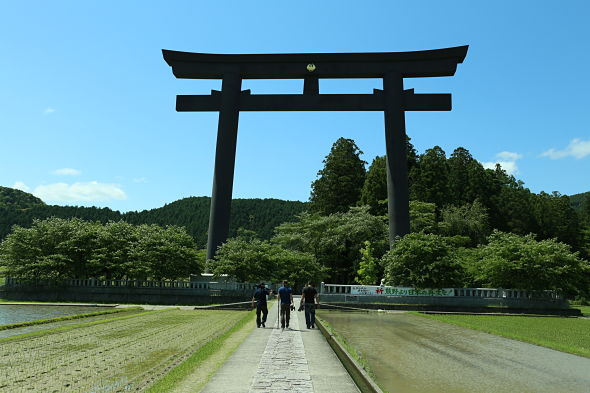
Paul, Yeray, Nacho and I arrived at the first of the sacred entries with the little delicacy of dragging the camera suitcases, As if we went to steal the magic to that monument between the rice fields and the Pantanal. The IDEs are hollow doors, so that between peace and the pilgrim, Two giant posts and a naughty formed the Honghü Taisha, WHAT IS WHERE WE START. Beyond, The temple enclosure began, incense, stairs and prayers. Going into Kumano Kodo is an infallible way to disoriented in the maze of creeds, But one tends to get lost with desire, Because there is no filigree, Nor dragons statue, nor peeled monk who does not cause a childish smile.
The sacred route of Kumano Kodo is a walk to nowhere
Stroke, Buddhists and animists share the way. They are different but compatible beliefs. Spirits, mountains, Buddhas and rivers, Everything fits if it is to find the balance. There is no confrontation, No tensions. It is not your God or mine, but shared gods, that even in that Japan knows how to order and here all the possible ways of faith fit.
Of the three sacred places, The most beautiful is that from Nachi Taisha. There the communion is perfect. A shiny temple, With its red pillars and its bells it gives way to a Buddhist, More sober and old. People come to pray to one and the other, I think that without making too many distinctions.
The Nachi Taisha enclosure looks out to a sacred waterfall, And from a tower of polyhedral roofs we saw the monks plunged into songs and prayers, facing the water jump. The landscape communion with the temples is such, that one feels the impulse to launch to pray there, without knowing very well to whom.
The landscape communion with the temples is such, that one feels the impulse to launch to pray there, without knowing very well to whom.
The last of the pilgrimage places is Hayatama Taisha. Repeat the ritual of faithful playing bells and monks accepting offerings. It is colorful, Like the other temples and ends up at a hill, in front of a huge rock.
Nature has inspired this route. The waterfall represents the woman, The rock to man and the pantanal is the communion of both. The temples of heaven and earth speak, of life and death. I didn't understand anything, Because it is impossible to understand faith. You have to walk the path and cross the forests, No cameras or emergencies to feel what they feel, To know each other pilgrim in search of answers, sin dogmas, Mochating in the wind of faith, Like bamboo. Maybe next time.
After temples binge, We ask for dessert the city of Koyasan. Maybe the most motley place of Buddhist buildings that exists in Japan. Buddhists have always seemed horny, Types that after the orange tunic and the fervor of the prayers transmit something that in the West seems almost incompatible with religion: joy.
You have to walk the path and cross the forests, No cameras or emergencies to feel what they feel
In Koyasan there are 120 Temples, one next to others, Huge temples with white facades and large gold, modest temple with very careful Japanese gardens or hotels-time, where the visitor can stay among the monks. And that's what we did.
Dinner served us in a diaphanous place, with the ground padded with mats and white paper walls. We drink rice and vegetables and drink aromatic tea. I interviewed one of the monks run by the hotel and told me with a grimace of foolish teenager to be a monk was very funny.
He did not seem seeing how they get up at dawn to read their scriptures among the gleaming statues of Buddhas, It didn't seem to have fun when they load food, In an arcane ceremony, To take it to Kobo Daishi, The founder of the Shingon School of Japanese Buddhism, that is so old, that has been dead for more than a thousand years. But from there, The day was lightened. The monks walked through the Zen gardens of the temples, They went shopping or called their monks friends with the mobile.
That night coincided with the Champions League final and between so much ceremony and so much prayer, We thought about asking if there was any way to see the game. It was not necessary, One of the monks who also presented himself as a staunch Madrid player approached us as intuiting the question we didn't want to ask:
-If you want to see the game put the channel 8 On the TV. I plan to see it-. Sentenced with a laugh
Faith cannot be explained.


