



Not long ago, Castilla when Arabs and Christians struggled together against themselves, when the ally was the reason, when Iberian lands were the last and a willingness to Spain dream, born in the middle of nowhere, strengths and secluded villas that made county, a place that time seems even hidden: the hermitage of San Baudelio de Berlanga, Berlanga in box, Soria.
A small stone house
Someone says, before embarking on the path that will get us there, that "what we see is a historic gem". The travel time and often make the statement in question becomes. Maybe, because in Spain chopped earth history, anywhere and makes a shadow, perhaps, due to the tendency that many guides and locals have to broaden "their" history.
The path follows the road with a sign indicates arrival at venue. I know nothing of this hermitage, some distant reference only vacuous. A slight slope and, with a stand and a parking, there is a small stone building. New, with little time, its façade there is not a trace of past and present itself to. What is this place for us astray? The guide is not intimidated: "The Sistine Chapel of the Mozarabic", announces, Follow me. Many enigmas hides », says.
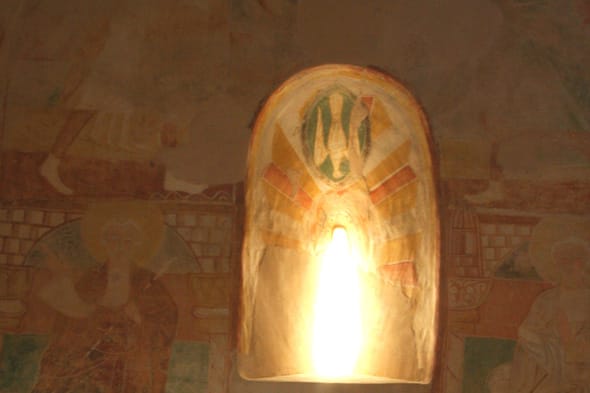
Everything changes once the door opens and lost shrine appears before our eyes an incredible place of which only traces and, however, stares you their paintings, their few rays of light that illuminate reddish color, mostly, which are first that, colors, figures are then disseminated, forms. So much, at first glance, San Baudelio es painting "Mozárabe», tell us, but then come the questions, doubts, the answers of what is known and what is not. The doubts come to its origin.
The paintings and, especially, palm holding the hermitage, are spectacular by unique. Never before had I seen a building resting on a "stone tree"
The guide strives to teach the obvious principle. (Everything is way easier to undertake it from where light, then, Getting into the parts go less clear). The paintings and, especially, palm holding the hermitage, are spectacular by unique. Never before had I seen a building resting on a "stone tree". It really looks like the Gothic columns, but here a perfectly distinguished branches exiting a trunk and, also, when the hermitage was born, talking about the tenth or eleventh, there were still several centuries to the first pieces of Gothic.
The palm grew, lifelike, in the middle of the enclosure. Its eight arms, simulating eight branches, hold or embrace all construction. The palm, Like all elements San Baudelio, have different explanations and symbolic. The entire area is a hymn to nature, of human wisdom flowing. Many answers not found in the visit. There are many studies out there about this hermitage. Most striking is likely today, yet, more questions than answers. Why a palm?
The staff of San Pedro, initiatory symbol of Christian heritage, Cane is a transformation of Irma measures Solomonic, representing wisdom initiation of medieval architects
The branches of the world and the Templars. Nicholás Wilcox, the alter ego of writer Juan Eslava Galán, A reference to this element and its discovery of San Baudelio: «The staff of Saint Peter, initiatory symbol of Christian heritage, Cane is a transformation of Irma measures Solomonic, representing wisdom initiation of medieval architects. The two come, ultimately, the rod of Moses and Aaron, that was the origin of Christian initiation. Well, San Cristóbal this rod or staff is represented twice in the giant palm descuaja and used as support to cross the river with Jesus back. The palm tree is a guardian of the Mother Goddess and is related to the Virgin in Christian iconography. We find it in the pillar that supports the roof of the chapel of San Baudelio, Soria, initiation site of the Templars. The aspirant was enclosed in the aedicule that exists precisely on the trunk of the palm tree ».
The Hermitage, built at the end of the tenth century by the Mozarabic, Castilla amid, draws on Iranian-Assyrian buildings. The circular is indicated by a strong central pillar shaped palm whose branches open on concealed the "lantern of the dead". The lantern of the dead on a column used in initiation ceremonies were repeated in many paintings of some Romanesque churches. It must have been quite common in some churches that replaced the ancient religion shrines », escribe Wilcox, speaking of templario use the enclosure and its relationship with Christianity. But, other authors speak of a Muslim. Common Symbology, in any case.
For Muslims, palm is also loaded with meaning. The palm tree is the "tree of the world", is the column that unites heaven and earth, and her palms have to link them with the numerical symbolism of the number of branches there.
Muslims are, perhaps, those that have delved into the esoteric of the palm. At its foot Mary gives birth to Jesus (not in the cave, as in Christianity). And the first mosque, Muhammad in Medina of, was made with palm…And the great Ibn al Arabi speaks of the Palm, "Aunt of Adam" because they both made the same germ. This interpretation of the palm of San Baudelio makes Angel Almazan, expert who has studied this enclave and offered a different version of the logic embodied in most books.
Muslims are, perhaps, those that have delved into the esoteric of the palm. At its foot Mary gives birth to Jesus (not in the cave, as in Christianity)
The meditation cave. The palm, (mother, the way…) is defined as before, hides, one last enigma. A niche, accessed by stairs surrounding the hermitage, small, very small dimensions. Since this space has been mentioned before. Wilcox is what called the "lantern of the dead". To Almazan is an egg-Iniciático. Place, not exceeding the square meter wide, is hidden by the branches, on top, at the very birth of the palms.
There are many versions and theories about this space. The guide invites us to come and see for ourselves the energy that flows there. Energy?? That is the reason for this space. There, seems, were the Knights Templar to perform some ritual that remains anonymous, but the camera placement and symbology which is placed (above and the palm) seems that it was bringing the knight to heaven, a Dios, in an almost physical contact. In fact, similar niche is preserved in the chapel of the Vera Cruz Templar Segovia. Inside the lantern of the dead there is peace, silence, and, influence or not everything learned and heard (it is difficult to separate the knowledge of touch), soft mysticism enters the small sliver of light that bleeds into the stone. Common to all the premises. Under this niche energy is a row of small columns that hide shadows. Shadows on shadows. No decoration in your environment. "More energy", says the guide. A place to keep treasures, suggest other. In any case, silence only sound. How long would, if it was so, and ritual iniciático?
A cruz or moon
What Muslim Mozárabe? San Baudelio has always been considered a jewel of Mozarabic: a mix of Muslim and Christian culture. Some theories say that was built after the conquest of this territory by Ferdinand I of León in 1960 and that the paintings were made between 1123 and 1125 . Almazan, instead, speaks of a building of Islamic origin, that would be Christianized from the year 1060. "Their main ship is a cube, as the Kaaba which is the temple par excellence of Islam. Its orientation is angular: the corners are the marking each address space (latitudes) and not as the primary side in Christian churches », explains. Addition, speaks of the influence of the palm in the Arab world and another set of data according to the author prove their Islamic origin. Yes, one another, match, regardless of origin, in building deep esotericism.
Why representation of animals as varied, even unusual?
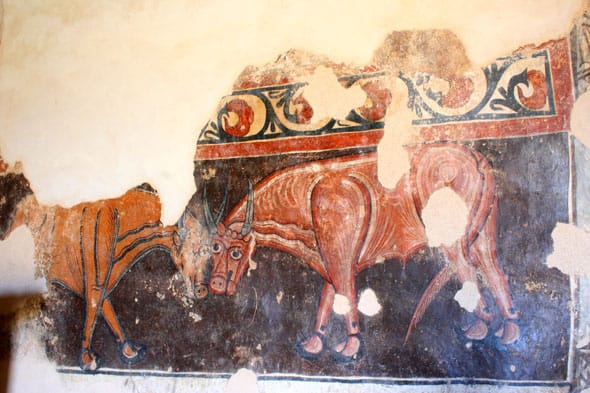
But San Baudelio is also considered the Sistine Chapel of Mozarabic. "A universe in which predominant architectural Romanesque painting», Experts say the Castile and Leon. Other, Experts also, that last move as much as the future, including guide, point out more and talk about Mozarabic. And other, the influence of the two styles, even their convergence on campus. There are detailed scenes of hunting and gospel passages. The latter are concentrated in the upper part of the enclosure, while in the lower part includes a full grandstand medieval bestiary where there elephants, Camels, dromedaries, Wolves, hares, Buffaloes…First question: Why representation of animals as varied, even unusual?
"The camel, for example is, primarily, Frame that helps cross the desert, through which you can reach the hidden center, the divine essence ».
It seems that many of these animals were part of the frescoes by its conceptual value. "The camel, for example is, primarily, Frame that helps cross the desert, through which you can reach the hidden center, the divine essence ». Again a related explanation Arab world. It may be logical. It was very common lands of Castile then the appearance of camels, camels and even elephants.
There are also many hunting scenes and many, we have already indicated, New Testament (no footprint is observed here and yes the Christian Islamic, which does not help us resolve the conflict symbolic). In any case, or there was a mixture of values ??and cultures in the origin of fresh or overlapped each other. What is indisputable is its beauty. The branches of the palm tree and decorative walls also meet with borders of abstract geometry.
Many of the frescoes of this place can be seen in the Boston Museum and the Metropolitan subsidiary, The Cloisters, in New York
But little is contemplated in San Baudelio its incredible initial mural. Lots of paintings crossed the border when Spain sold art for bread. Because, although it seems credible (not amazing) , and it is, much of the frescoes of this place can be seen in the Boston Museum and the Metropolitan subsidiary, The Cloisters, in New York. A few other, which were kept in dollars, are in the Prado museum (perhaps the most representative). In the Big Apple, eg, Painting is a dromedary, and three high frieze paintings of San Baudelio: "Jesus giving sight to the blind", "Raising of Lazarus" and "The three temptations of Jesus'. The paintings were sold off to a century antiquarian who was the Yankee fitted a millionaire, which installed them as decoration in his mansion. Now you try to return to their home, Soria.
San Baudelio, with historical doubts, is a perfect representation of what was Spain in the tenth and eleventh. A mixture of cultures, that became entangled in colors and shapes. Difficult to distinguish at source, because whatever it was, probably the chapel was a holy place for Muslims and Christians originated in a close. That without politics and wars through, both cultures were able to share symbols and prayers, as words were exchanged until the dawn of time and they fell on the whisper of peace became the sound of war drums. Go, open the door of the modern white cube that is the facade and discover the mysteries of the hermitage where nature lives in harmony with man.


