



Like so many symbols of glory shone before burning, Sarajevo followed that script in the twentieth century when it passed, successively, from hand to hand until it became the capital of an independent country. Today, Bosnia-Herzegovina, tries to shake off the dust from the ashes of history.
Walking the streets of Sarajevo to recall, inevitably, more immediate memories in time. Of course maybe that's as easy to feed, in the social imaginary, what made twenty years ago Sarajevo on the covers of every newspaper in the world: a civil war now and just give in memory thrashing, on the facades of buildings riddled or plates that hang from many monuments throughout the city with the name of hundreds of dead.
Although Sarajevo is much more, this fact monopolizes, largely, thought. In the "Jerusalem Bosnian", as called by the coexistence of various religions, stay in the city begins in Bascarsija, the bazaar in the heart of the city built six centuries ago, with the founding of Sarajevo. On this old extension up the most attractive monuments.
Walking the streets of Sarajevo to recall, inevitably, more immediate memories in time
His story is a metaphor for closeness of Gazi Husrev-Beg's mosque, the Cathedral of the Sacred Heart of Jesus, the old Orthodox church and the synagogue of Sarajevo. With three holy days a week, corresponding to Christianity, Islam and Judaism-, Sarajevo went from relying on the Ottoman Empire Austro-Hungarian Empire until well into the twentieth century. Bosnian, Croats and Serbs live together in relative harmony in the light at the end of the last century ethnic differences led to cruelty fueled by the megalomania of "Greater Serbia".
Although this is a journey through the city, connect with their recent history is essential to understand a city rebuilt but not our objective to know in depth the intricacies of history and international politics.
Although this is a journey through the city, connect with their recent history is essential to understand a city rebuilt
The course of the previous four centuries of myths and the nation's blood was drawn by Ivo Andric In "a bridge over drina", a book of great intensity with the stone bridge to witness the time Visegrad, on the edge Serbia. Precisely, last year were met 50 years of the Nobel Prize award.
Shortly before the creation of Yugoslavia, Andric date where the route ended the story in his book magnum, Sarajevo dawned with the assassination of the heir of the Austro-Hungarian, the Archduke Francisco Fernando of Austria and resulted in the Great War. The Puente Latino, where a Serbian fanatic killed the heir and his wife, stands on the river Miljacka impeccable despite being one of the most historic in the city.
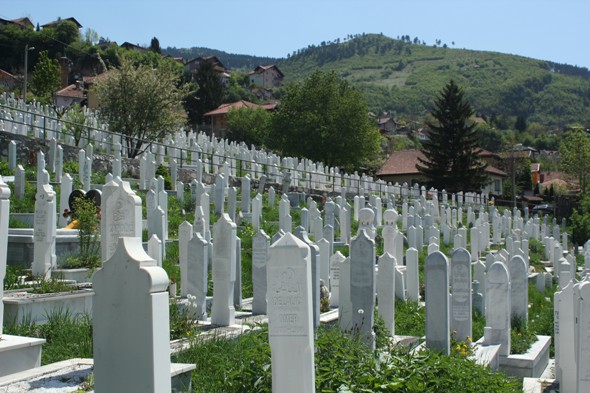
The river crosses the city from east to west, as a mighty line in the middle of the valley that is home escorted by five major mountains that reach up to two thousand meters. In this place were held Olympic Winter Games 1984, and the edge of the river is the Library of Sarajevo, that during the war lost more than two million documents when the Serbs destroyed. Practically the whole city turns to the north of the river, leaving the southern suburbs and one of the skirts on the rising Sarajevo. In a "u", houses dotting both walls of a city long that vibrate to the sound of Miljacka and, whose slopes, the target of thousands of tombstones living with the lush green of Sarajevo.
Sarajevo, cultural haven
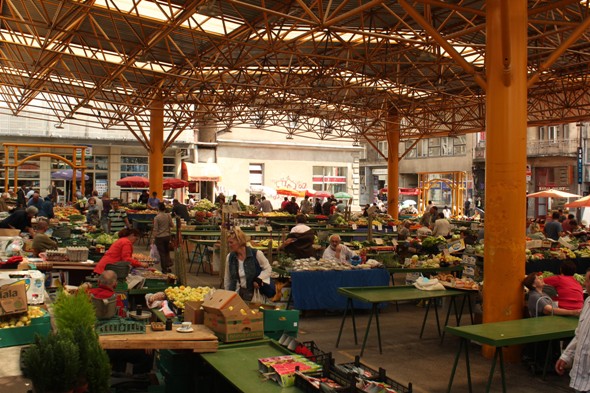
During the siege the population remained stifled for nearly four years, the pulse beat on weaker, but it was normal to make a bearable companion. That I remember the images presented in these weeks National Museum, where the snapshots show the raw reality. People crossing the streets in the shadow of the United Nations armored, lines at the Markale market, where two bombings killed dozens of people. Or even the promotional poster of the Winter Festival 1993, where you see Smail?, the "Cellist of Sarajevo", Squeezing your instrument musical notes in the middle of the ruins of Sarajevo Library.
Theatrical performances and art exhibitions sprouting in an unusual environment. And in a city whose appearance changed attacked buildings and urban gardens where once there were beautiful gardens and courtyards, art with recycled materials also struggled to alleviate cruelty. A Bosnian artist once said that the city during the war was "a mass culture of the proletariat". But art technique involved a detachment from reality even if the raw material came from the remains of bombing.
The trace of a strange routine is inevitable climb toward Vraca neighborhood or across the Avenue of the Snipers
Therefore, the trace of a strange routine is inevitable to trace to the Vraca neighborhood or crossing the call Snipers Avenue, where stands, gold and imposing, el hotel Holiday Inn. This hotel would go relatively unnoticed if not constitute a symbol in the memory of the reporters who covered the war and who were staying there working in harsh conditions.
Isolated from the outside world, the city was accessible only by air. The great reporter Enrique Meneses recalls how he could get there to work, air. But the people who suffered the siege was more cruelly. At the end of the day, remained with all access to the valley shielded. Held his breath against it, in small doses, through a tunnel dug outside the city. Now a museum and you can visit.
Back to normal
Every step you advance in the Bosnian capital appeals to the imagination. Unlike the ancient buildings of ancient civilizations, here, just three hours by plane from Madrid, a façade or a building can lead to many discussions and debates.
After the shock to cross the city, should assume in the hustle and night weather youth center, where terraces and restaurants are flooding. Within walking distance is the modern Bascarsija the Sarajevo, glass buildings as witnesses to the actual splendor, but the concentration of drinks and dinner youth gather around the alleys and hidden squares of the historic heart.
Sarajevo has returned to apparent normality scarred in many places
They say many voices was the most merciless war is remembered. But Sarajevo has returned to apparent normality scarred in many places. Today has once again restored as a magnet for tourists and travelers each year choose this destination. The thing to note is the inability to stay out of what 46 month siege left: we know that any young 20 years living in Sarajevo Bosnian survived a war. A good brainstorming exercise.


