


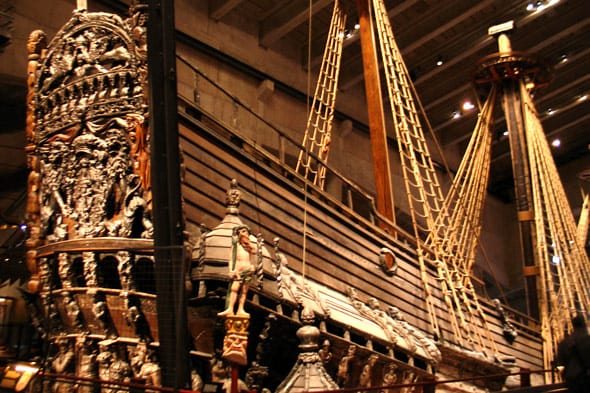



I have always been more interested in the trail that a defeat leaves than that of a triumph.. A loser has more backrooms and is lavish in edges. Therefore, the story of a ship launched with salutes of honor that sinks on its first voyage, without even leaving the port, It aroused sympathy and curiosity in me in equal measure.. The Vasa was the pride of Gustavus Adolf II, king of Sweden, to the point that he was baptized with the name of his dynasty. The construction of this modern warship had taken two years. Nothing like it has ever been seen. With 69 meters, 1.200 tons of weight and 64 cannons on board, the Vasa was destined to amaze the world. And wow he got it.
Everything was prepared that 10 August 1628 in the port of Stockholm. The first voyage of the Vasa had raised logical expectations. The amazing ship, capable of displaying up to ten sails, finally set sail among the joy of curious onlookers and authorities, but two gusts of wind were enough to knock the giant down. The ship listed and water began to pour into the gunboats.. The Vasa sank in the same port to the astonishment and disbelief of those present.. They had gone to a party and, suddenly, They were at a funeral: 30 of 200 crew members drowned.
Its construction had taken two years. Nothing like it has ever been seen. The Vasa was destined to amaze the world
Another shipwreck of those that mark the audacity of man facing the sea? At all. three centuries later, Anders Franzen I was a child who dreamed of shipwrecks. At the beginning of the decade of the 50, ready to continue dreaming, he set out to find the Vasa. And he achieved it six years later, in 1956. Franzen had stumbled upon a relic from the 17th century. The ship was refloated in April 1961.
When I visited the Vasa Museum In Stockholm I already knew that the ship was exposed inside, with its original structure almost intact. I had even read numerous opinions from travelers who pointed it out as one of the essential places in the Swedish capital.. But when I entered the museum and met the Vasa, immense and powerful, solemn and resplendent, with that legendary aura that always accompanies a failure, I was absolutely fascinated.
The amazing ship finally set sail amid the joy of onlookers and authorities, but two gusts of wind were enough to knock the giant down
The old warship defeated by the sea, perhaps to remind men that we are mortal, had recovered the dignity of his ephemeral voyage, frozen during 333 years, to the amazement of the world, Now. It was the perfect metaphor for the rewards of failure. (which are often underestimated). It was admirable to see how the Swedish people had been able to redeem such a memorable fiasco into a milestone.. That is, precisely, the main lesson of the museum. It is easy to defend the triumphs. The complicated thing is to overcome a setback and teach defeat.
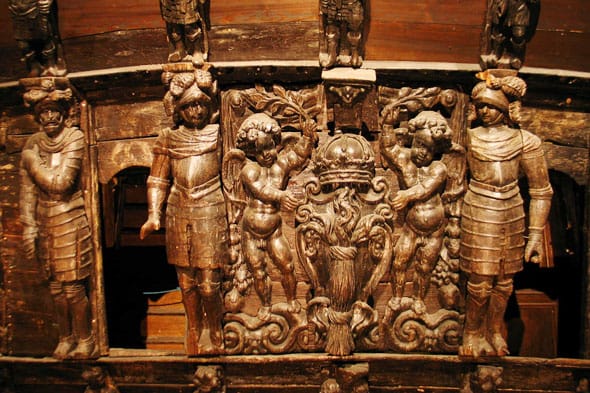
There were their 700 Sculptures, which were placed in their original position after quite a few headaches, its defiant bow lion, the very careful stern to the greatest glory of the Swedish dynasty, capable of astonishing Neptune himself. And, also, the succession of cannons that spelled his downfall. The king's whim forced the construction of two decks and, as a counterweight, the bottom of the ship was filled with stones. But, the first setback, those 120 tons were unable to keep the ship balanced.
It was admirable to see how the Swedish people had been able to redeem such a memorable fiasco into a milestone.
The Vasa is located in the center of the main ship and one can admire its workmanship as you ascend the different floors that surround the ship and allow you to appreciate its entire structure in detail.. I was engrossed, truth, and I never got tired of turning from one side to the other. Especially after seeing, on the street floor, a documentary about the history of the Vasa (in 16 languages) and his laborious recovery, which helps to understand the magnitude of the company. Leave the projection room afterwards, with the images of the film still on the retina, and finding the ship in front of you is really shocking.
How is it possible to be admiring a ship that has spent more than three centuries submerged underwater?? The waters of Baltic, that do not frequent the mollusks that devour wood, They were the first allies. But, yet, once recovered from the sea, the Vasa was sprayed for years with preservatives to ensure its survival. But the conservation of the ship is a constant challenge, since the wood is impregnated with sulfur (due to water pollution) that, upon contact with oxygen, derives into sulfuric acid, a serious danger to its aging structure.
When I met the Vasa, immense and powerful, with that legendary aura that always accompanies a failure, I was absolutely fascinated
The museum also exhibits a multitude of pieces and equipment rescued from the waters. (they almost recovered 14.000 wooden objects, plus the skeletons of some sailors) And in a low roof stay he reproduces a daily scene of life on board that allows to perfectly imagine the hard conditions of the crossings at that time.
The crew is also put face -and that was one of the parts of the museum that attracted me the most-, recovering their personal stories and even their faces, A documentary boast that pushes you to jump from one experience to another, scrutinizing in their lives with the same familiarity, At that point of the visit, with which you would dig in your family tree. But Vasa Museet closed in a few minutes and the lights began to go out. The latest visitors abandon the place with a jarism adar, without wanting to once and for all turn my back on the imposing ship of broken dreams rescued from oblivion.
El Vasa Museum (www.vasamuseet.se) It is located on the island of Djurgarden (Galärvarvsvägen, 14), in Stockholm.


