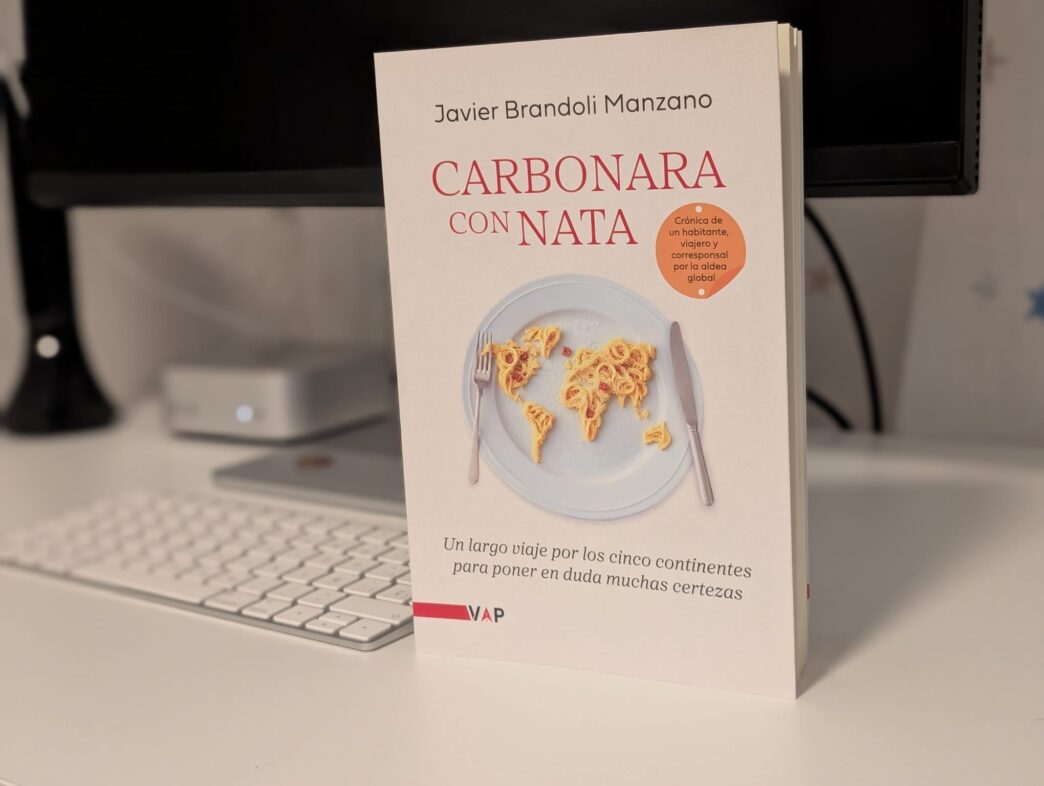
There are books that can be read like someone reading a map.. And there are others that are more like an after-dinner session because they are full of detours., comfortable silences and questions that do not close, but they push new ones. Carbonara with nata, by Javier Brandoli, clearly belongs to this second category: a book that focuses on the beauty that grows from the fissures of the world, and leaves the reader satiated, but not completely. There is always room for dessert, for another coffee, one more story. That is what the author gives us: stories that open other stories. Stories that remind us that life and literature are full of possibilities that explode—like mines—when we walk over them.. A book that, upon finishing it, makes it clear that the conversation is not over and that the table is still set.
For years, Brandoli has inhabited cities, conflicts and routines with the perspective of a journalist who focuses on human dignity. Your ability to renounce the big headline and the sensationalist approach, and to place the people who trust him with their stories at the center, goes through his texts. A read and feel that you are part of that care, of that respect that makes the world a more livable place. Javier knows a lot, and yet builds his stories without imposing himself from certainty, leaving room for the reader to make their own conclusions. It doesn't tell us what to think, it simply points out where what happens happens and invites us to look.
The title, provocative and almost irreverent, works as a declaration of intent: The seemingly trivial can contain a profoundly complex truth.
The title, provocative and almost irreverent, works as a declaration of intent: The seemingly trivial can contain a profoundly complex truth.. As if telling the world requires accepting that there is always something that escapes us, that every look is partial, that every story could have been another. And, even when we think we have the recipe, each one ends up doing it in their own way - even if it is uncomfortable, piss off or raise tension.
From there, the conversation opens:
1. The title Carbonara with cream attracts attention from the first moment. In what moment that name appeared and why did you feel it should stay?
He lived in Rome, era 2022, and I was about to go live in Bangkok when the idea for the book arose, which comes from a blog I wrote in El Confidencial for three years.. A thing as simple as carbonara, I explain it at the end, symbolizes how complicated it is to understand and relate the world. But, So many people told me that the title was very bad and was confusing that I decided to remove it.. A meeting with distributors, that they loved, he recovered it. And I'm happy because the book was born with that idea, although maybe, as some tell me, ended up on the recipe book shelves.
2. The journalist usually moves between observation and personal involvement. How you find the balance between telling what you see and not becoming the center of the story?
My previous book, The African Macondo, told a more personal story: I was in the middle of that southern Africa that fascinated and surprised me. In this book I wanted to be just the driving vehicle. The work collects dozens of very valuable voices of people I have encountered. They are the protagonists. I have worked a lot on the book, It has been more than three years and there have been at least six finished editions. In the first Carbonara with Nata maybe I was too far away, It was almost a succession of journalistic chronicles, and finally I was finding more the rhythm and the way to get into the story. The book starts from certainty to doubt, which is the path I have taken listening to those voices.

3. You have worked in very different contexts, from European cities to stages of conflict. Is there any place that has especially changed the way you look at the world? world?
I guess all. It has been a process. But I would say that I insisted that we go to Bangkok with the idea of writing this book.. I spoke with Francesca, my partner, and we push to go there to have the experience of living on all the great continents and finish the work. And I think that Asia, I traveled a lot, It has been the place where I have learned the most and observed that there are other ways of ordering life..
4. Journalism usually focuses on the extraordinary. Do you think that everyday life has also its own form of epic?
The book certainly tries to be an ode to that.. What fascinates me most is everyday life.. A problem with journalism is that it is a business whose clientele pays for a product that should inform/entertain them.. And the routines entertain little. I realized that the reports and news that he told about the countries, I felt it especially in South Africa and Mexico, They did not reflect my daily life. Even in the midst of horror there is a daily life. Human resilience fascinates me.
I realized that the reports and news that he told about the countries, I felt it especially in South Africa and Mexico, They did not reflect my daily life
5. After so many years traveling and telling stories, Has your way changed? understand the word “normality”?
It has changed my way of understanding everything. I doubt everything. I have never in my life trembled so much at a keyboard as I do now.. I review, I, contrast… And usually I finish and continue doubting. What is normal? It depends on the uterus from which you fall and where you fall and your response would be different.. And if you reconsider that, that is coincidental, you must start doubting everything.
6. Travel writing has a long literary tradition. What authors or readings have influenced the most in your way of narrating the world?
I read many different authors. Every time I change country I start reading about the place I arrive at. for love, I would say that Javier Reverte, but that strikes a personal chord. In any case, The travel book that has stimulated me the most is “The Shortest Path”, de Manu Leguineche, but I am not able today to abstract myself from the subsequent controversy that there are invented fragments. Then, Many years ago I read “From the Lake of Heaven”, de Vikram Seth, and he marked me a phrase that says: “Sometimes it seems to me that I wander the world to accumulate material for future nostalgia”. I debate a lot about that., about the current meaning of traveling.
Then, There are books like “Of the ruins of empires”, del indio Pankaj Mishra; “To combat this era”, the Rob Riemen; “Dead Aid”, by Dambisa Moyo; or “The Dead and the journalist”, by Óscar Martínez…,to say some, that have stimulated me a lot and influenced me in Carbonara con Nata. These are not some travel books, but they make you move to other ideas and worlds. And finally, andor I would like to have written “The Innocent Anthropologist”, Nigel Barley, I'm not sure if it would be published today, “Naples 1944”, the Norman Lewi, a chronicle masterpiece. I laughed out loud while reading them., and nothing seems more difficult to me than to provoke that by narrating such crude realities..

7. Often the journalist arrives, listen and leave. What happens to those stories? when the journey ends?
We make portraits of a moment, of some circumstances and some specific protagonists, that sometimes they are coincidences. You come across one and not another with whom if you had perhaps spoken the article you send would be different. That is why correspondents are needed, people who live on the land, who can go back and weigh those casual words. The pulse of a place cannot be understood from a hospital or a trench. Life is what happens in the markets, public transport, cocktail bars, entering a workshop, looking from your window to the street...
8. Travel is often presented as a form of discovery. After so many years traveling the world, Do you still feel that same initial curiosity?
Curiosity yes, adrenaline or emotions is what something has changed. It would be hypocritical to say no.. I lost a certain innocence that helped generate butterflies. I was slow. I had neither the courage nor the talent to go home with 20 years to travel the world. I have done everything step by step, but I didn't stop and that's why I ended up going so far. stepped, I felt safe, and stepped again. Sometimes I miss that guy who thought getting on a minibus in Cape Town thought something remarkable and wrote about it on his blog. But I do maintain curiosity. I am a journalist because I am curious. Journalism forces me to be interested in what interests me nothing, and that entertains me a lot. Journalism has made me lazy on some trips.
More and more I like to return to the places I've already been.. Sad nostalgia has to do with the sad present, not with yesterday.
9. When you return to a place years later, What are you most interested in observing?: what has changed or what remains the same?
what a good question! I guess I look more for what stays the same, I look for my trail to feel at home again. What has changed a lot is that I have stopped believing in a phrase by Joaquín Sabina that says “you should not try to return to the place where you have been happy.”. More and more I like to return to the places I've already been.. Sad nostalgia has to do with the sad present, not with yesterday.
10. What mistakes are most frequently made when trying to understand a country that does not is his own?
The ones you already had in your suitcase.
11. A reader finishes Carbonara with cream and closes the book for a few seconds in silence. What would you like him to take with him??
A huge desire to travel.